
Introduction
In India, financial independence is not just about having money; it is about having a voice in the family and society. For millions of women in rural and semi-urban India, managing daily household expenses while dreaming of starting a small business is a constant struggle. Rising inflation and family responsibilities often make it difficult to save money or access capital from big banks, which often require extensive documentation and collateral.
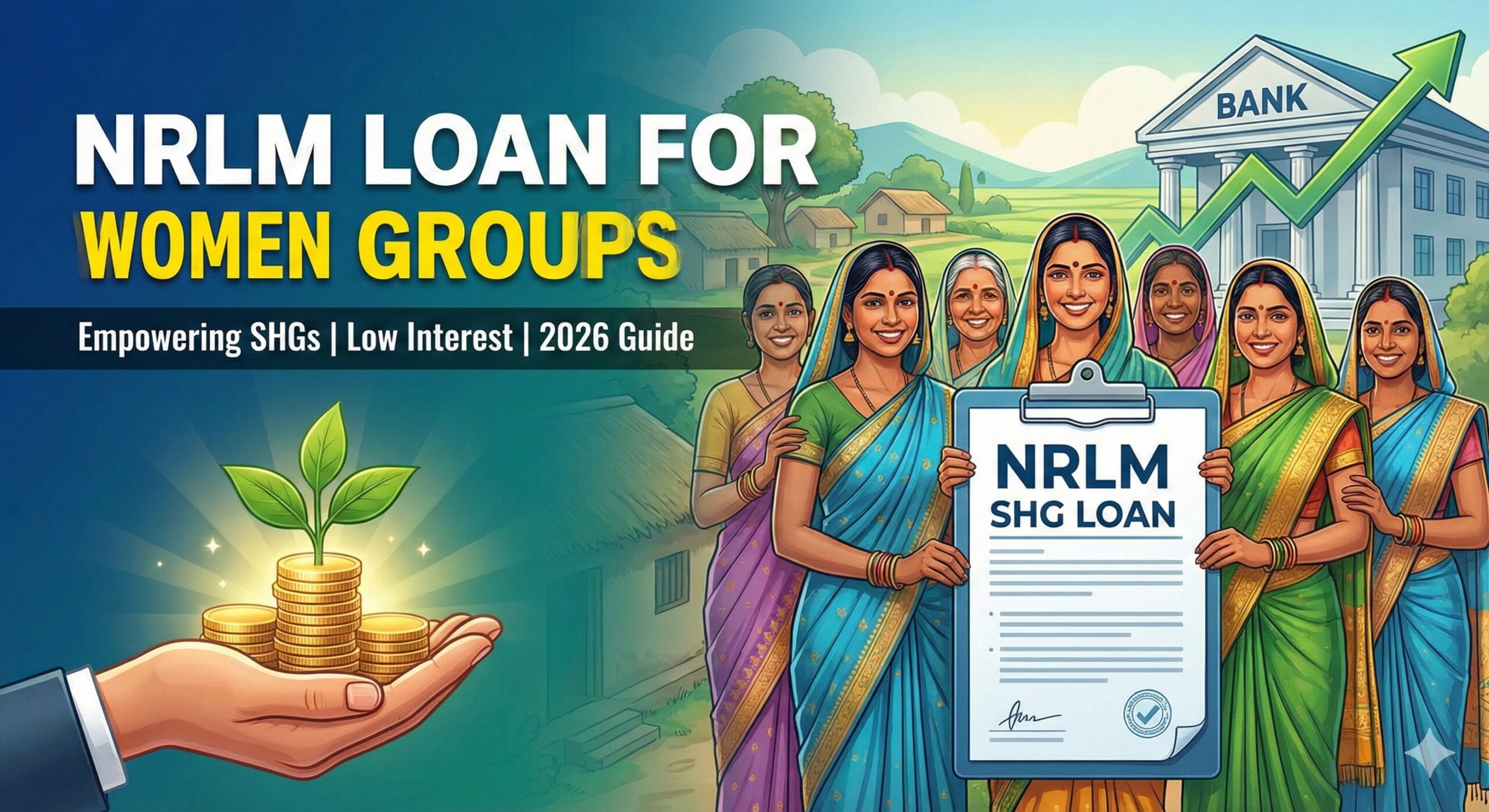
However, the government has created powerful support systems to help women stand on their own feet. One such revolutionary scheme is the NRLM loan for women groups under the Deendayal Antyodaya Yojana (DAY-NRLM). This scheme is designed to empower women through Self-Help Groups (SHGs), providing them with easy access to funds without the stress of collateral or heavy paperwork. It recognizes that when you empower a woman, you empower an entire household.
This guide is firmly based on the common financial habits and challenges faced by Indian households. We will explain exactly what NRLM is, how women groups can access funds like the Revolving Fund (RF) and Community Investment Fund (CIF), and how to use this money smartly to build a secure future. Whether you are a group leader or a new member, this guide will clarify every step of the journey.
Table of Contents
What is NRLM (DAY-NRLM)?
The National Rural Livelihood Mission (NRLM), also known as Aajeevika or DAY-NRLM, is a flagship program by the Government of India. Its primary goal is to reduce poverty by enabling poor households to access gainful self-employment and skilled wage employment opportunities. It operates on the belief that the poor have a strong desire to come out of poverty and they have innate capabilities to do so.
Unlike traditional bank loans that require property papers or gold as security—assets that many women do not own—NRLM focuses on the power of “social collateral.” This means that women trust each other, guarantee each other’s loans, and grow together. The mission aims to mobilize 10-12 crore rural households into Self-Help Groups (SHGs) and link them to sustainable livelihood opportunities, creating a strong network of grassroots institutions.
Why Financial Independence Matters for Indian Women
Before diving into the loan process, it is important to understand why these funds are crucial for the fabric of Indian society.
- Emergency Fund: Life is unpredictable. Medical emergencies, crop failures, or sudden household repairs can devastatingly impact a family’s stability. Access to SHG funds acts as an immediate safety net, allowing women to borrow small amounts quickly without facing humiliation.
- Breaking the Debt Trap: Many families rely on local moneylenders (Sahukars) who charge extremely high interest rates (sometimes 30-50% annually). NRLM loans offer a much cheaper, regulated alternative, helping families escape the cycle of high-interest debt.
- Future Goals: Whether it is educating children, buying livestock, or repairing a house, having access to credit helps women plan for the long term rather than just surviving day-to-day.
- Respect and Dignity: A woman who contributes financially to the household commands greater respect and has a say in family decisions. Economic empowerment leads to social empowerment.
Understanding Self-Help Groups (SHGs) and Panchasutra
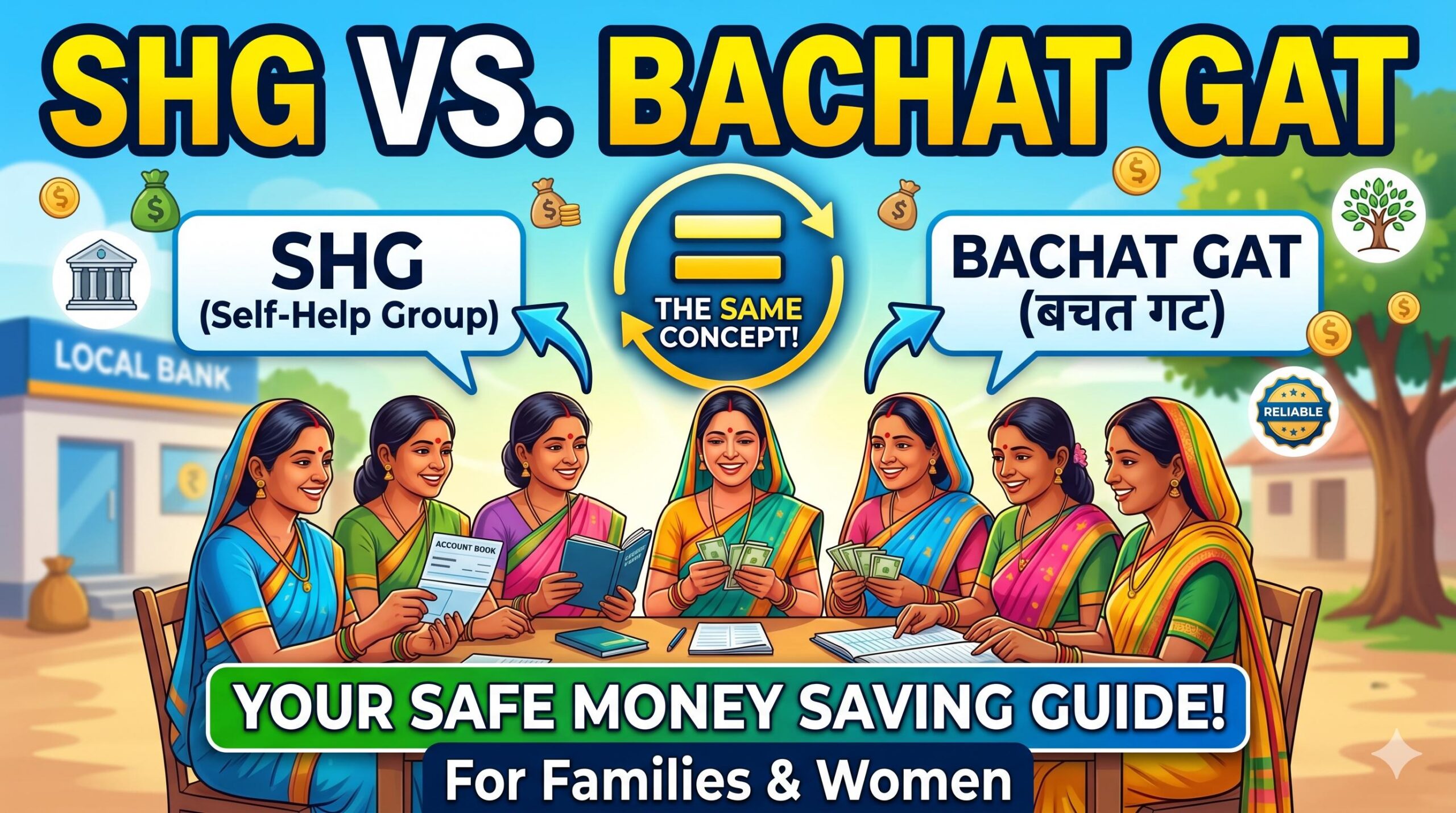
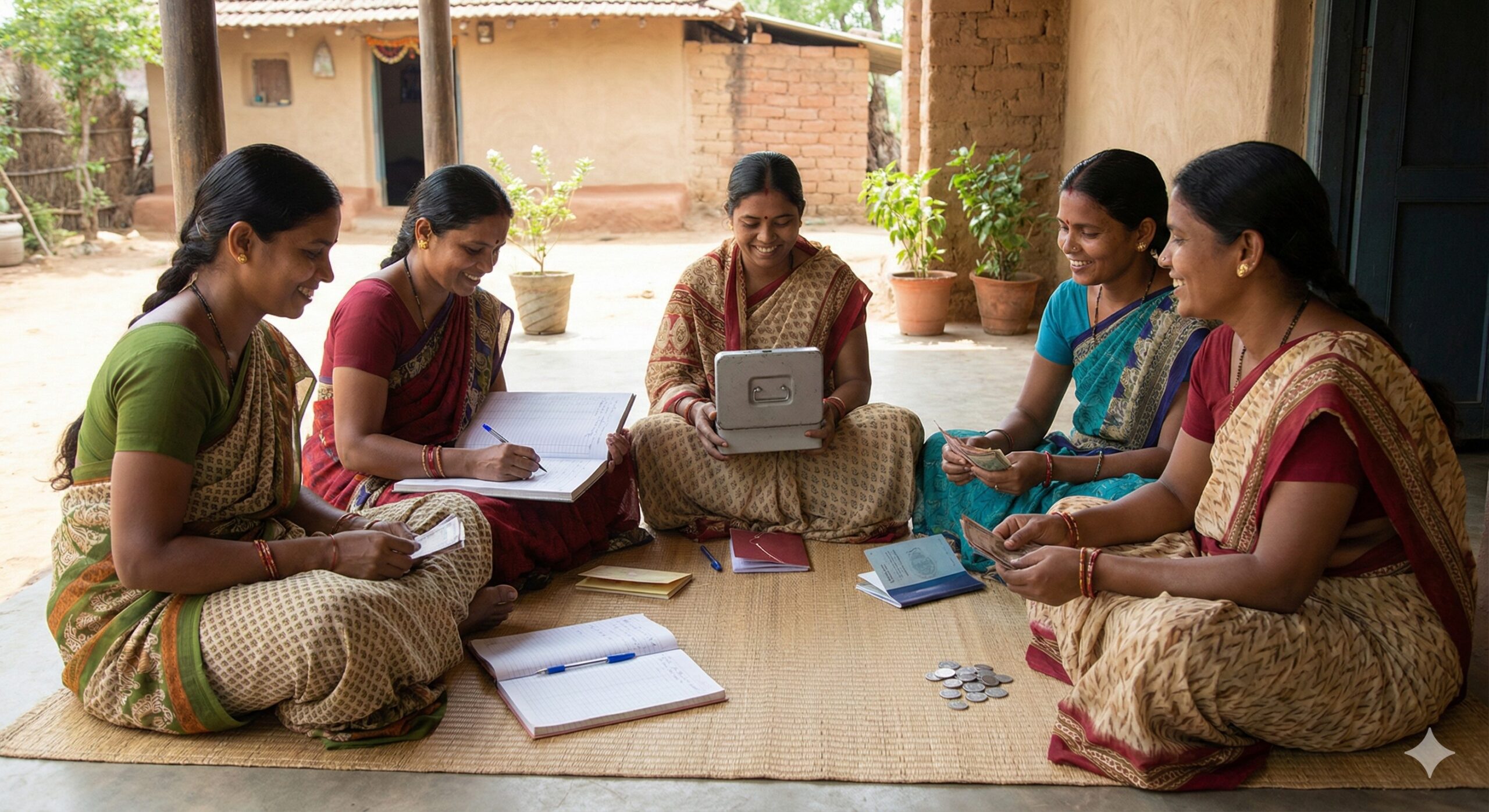
The foundation of the NRLM loan for women groups is the Self-Help Group (SHG). An SHG is a group of 10 to 20 women from a similar socio-economic background who come together to save small amounts of money regularly.
For an SHG to be eligible for government funding, it must follow the “Panchasutra” (Five Principles) strictly. These principles are the “credit score” of the group:
- Regular Meetings: The group must meet weekly or fortnightly at a fixed time and place. This builds discipline and bonding.
- Regular Savings: Every member contributes a fixed amount (e.g., ₹20 or ₹50) at every meeting. This builds the group’s internal capital.
- Regular Internal Lending: The saved money should not sit idle in a box. It must be lent to members who need it for small needs.
- Regular Repayment: Borrowers must return the money on time with the decided interest. This ensures the money keeps rotating.
- Regular Bookkeeping: Maintaining proper registers (minutes book, savings book, loan book, and cash book) is vital for transparency and bank grading.
Types of Funds Available under NRLM
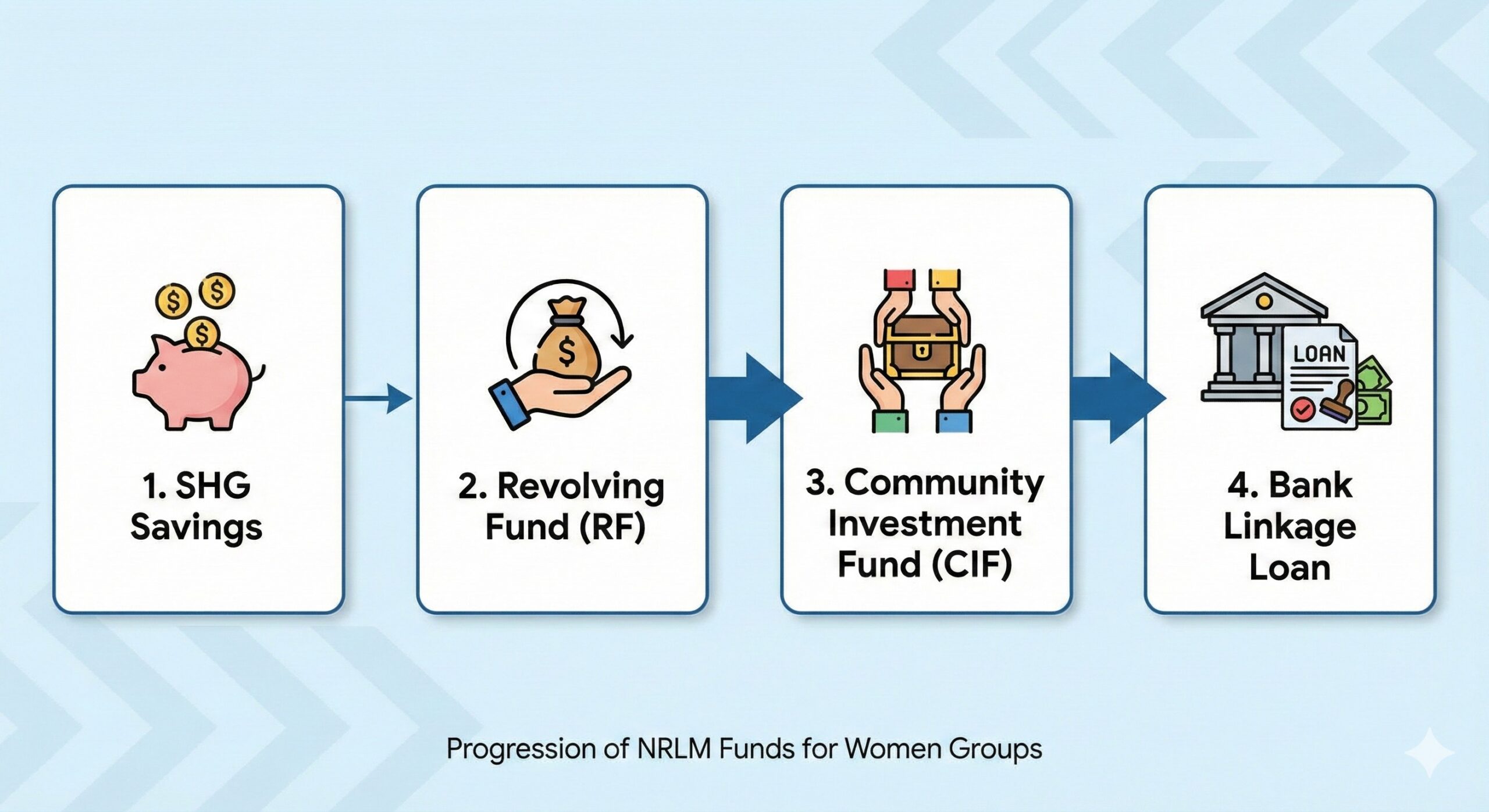
NRLM provides financial support in stages. It is not just a single loan; it is a ladder of financial growth designed to increase the creditworthiness of the group gradually.
Revolving Fund (RF) Once an SHG has been functioning well for 3 to 6 months and follows the Panchasutra, NRLM provides a one-time grant known as the Revolving Fund.
- Amount: Usually ₹15,000 to ₹30,000.
- Purpose: This is not for spending but for rotating. It is meant to increase the group’s internal lending corpus, allowing more members to take small loans and encouraging the habit of thrift and credit.
Community Investment Fund (CIF) This is a larger amount given to the SHG through their federation (Cluster Level Federation or Village Organization). This fund is a major boost for the group.
- Amount: Can range from ₹50,000 to ₹2.5 Lakhs depending on the state and the SHG’s Micro-Credit Plan (MCP).
- Purpose: To support income-generating activities and larger personal needs. Unlike RF, this amount often needs to be returned to the federation over a long period so it can help other groups.
Bank Linkage Program This is the most significant aspect. Banks are mandated to lend to SHGs without collateral. The loan limit increases in “doses” based on repayment performance.
- First Dose: Up to ₹1.5 Lakhs or 6 times the savings (whichever is higher).
- Second Dose: Up to ₹3 Lakhs.
- Third Dose: Up to ₹6 Lakhs (and higher in subsequent stages).
Eligibility Criteria for NRLM Loans
Not every group gets a loan immediately. To access the NRLM loan for women groups, your SHG must pass a “Grading” exercise conducted by the bank or the block office.
- Active Existence: The group should be actively functioning for at least 6 months.
- Savings Habit: There must be evidence of regular, uninterrupted savings by all members.
- Book Management: The group’s registers must be updated, clean, and transparent. Incomplete records are the #1 reason for rejection.
- Democracy: Decisions should be made collectively. If only the President or Secretary decides who gets the money, the group will be graded poorly.
- Previous Repayment: If the group took an internal loan or RF, it must have a good repayment track record (usually a recovery rate of 90% or higher is required).
Read More: SHG Bank Linkage Scheme 2026: New Loan Limits, Interest Rates & Eligibility Guide
Step-by-Step Application Process
If your group is ready, here is how you can apply. The process is designed to be transparent.
Step 1: Pass the Resolution In a group meeting, members must discuss who needs the loan and why. A formal resolution must be written in the “Minutes Book” stating the intent to apply for a loan and signed/thumb-printed by all members.
Step 2: Prepare the Micro-Credit Plan (MCP) For larger loans (CIF or Bank Loan), the group must prepare a plan showing how the money will be used. For example, “3 members want to buy a cow, 2 want to open a shop, and 1 needs it for education.” This proves to the bank that the money will generate income.
Step 3: Document Collection Gather the KYC documents (Aadhar, PAN/Voter ID) of all members and the authorized office bearers (President, Secretary, Treasurer). Ensure the group’s PAN card is ready.
Step 4: Visit the Branch or Bank Sakhi Submit the application to the bank branch where the SHG savings account is held. In many villages, a “Bank Sakhi” (a banking correspondent agent) is available to help illiterate members fill out the forms correctly.
Step 5: Grading and Sanction The bank manager or a field officer may visit your group meeting to verify records. Once they are satisfied with the “Panchasutra” compliance, the loan limit is sanctioned and credited to the SHG account.
Interest Rates and Subvention Benefits
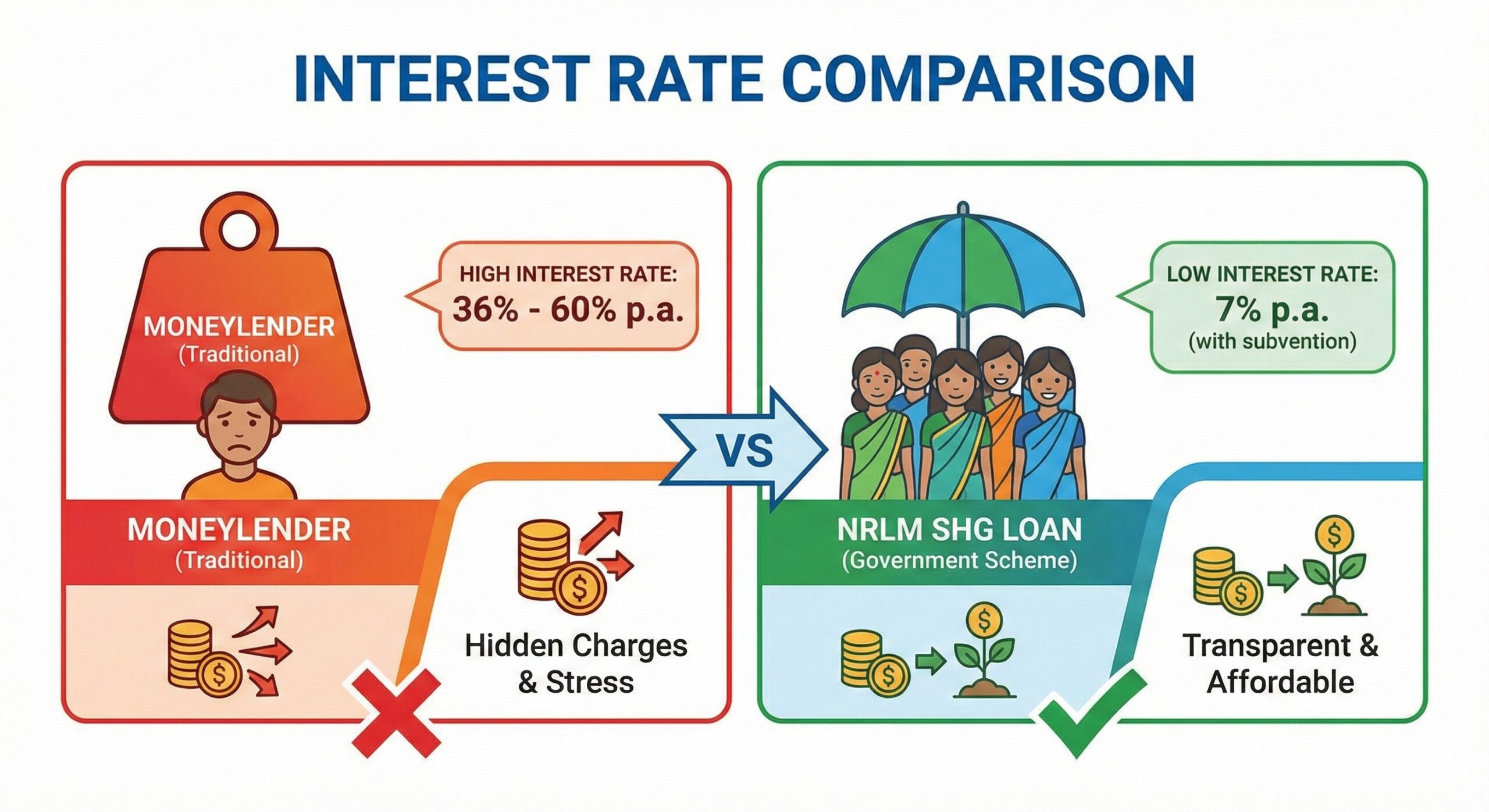
One of the biggest advantages of the NRLM scheme is the affordable interest rate, which makes it far superior to informal lending.
- Standard Rate: Banks usually charge between 7% to 12% per annum for SHG loans, depending on their internal base rates.
- Interest Subvention Scheme: To encourage good repayment habits, the government offers an interest subvention (subsidy).
- In 250 identified “intensive” districts, SHGs get loans at 7% interest up to ₹3 Lakhs.
- If the SHG repays promptly (on or before the due date), they get an additional 3% subvention, bringing the effective interest rate down to just 4%.
- In other districts, the interest difference above 7% is often reimbursed by the State Rural Livelihood Missions directly to the loan account.
Documents Required for SHG Loans
Having your paperwork in order is critical for quick approval. A missing document can delay the process by weeks.
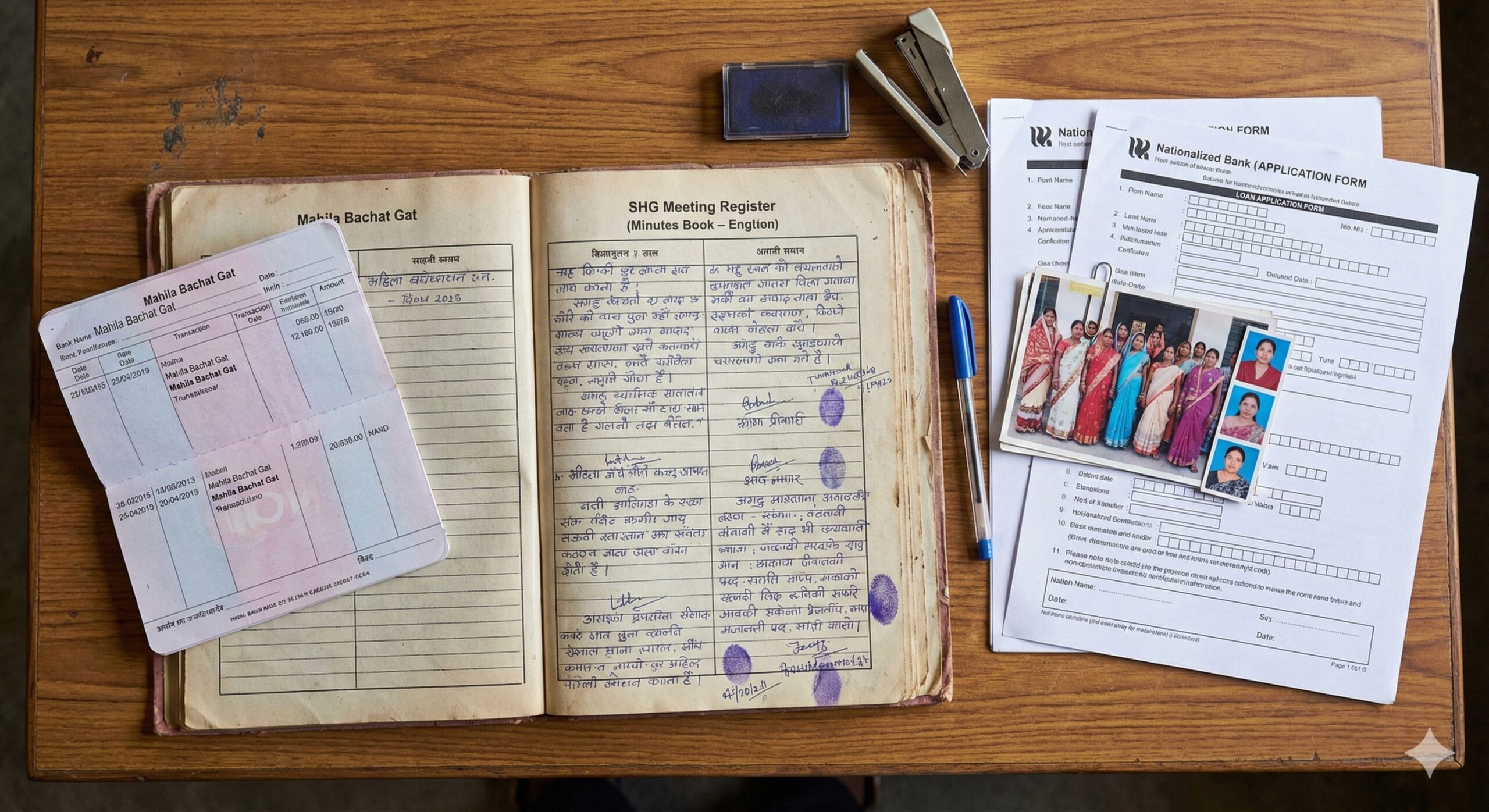
- SHG Resolution Copy: A copy of the minutes from the meeting where the loan decision was made.
- Inter-se Agreement: An agreement signed by all members authorizing the office bearers to operate the loan account. This binds the group legally.
- Application Form: The prescribed application form for SHG loans (available at the bank or BMMU).
- Photos: Recent passport-sized photos of the authorized signatories (President/Secretary) and a group photo.
- Passbook Update: The updated savings account passbook of the SHG to prove regular transactions.
- Grading Sheet: A copy of the grading sheet certified by the Block staff or Bank Sakhi.
Smart Ways to Use SHG Loans for Income Generation
Money borrowed must be used wisely. If it is used only for consumption, repayment becomes difficult. Here are practical ideas for Indian households:
- Agriculture & Allied Activities: Buying high-quality seeds, fertilizers, or small farm equipment. Investing in dairy farming (buying cattle) or goat rearing is a popular choice as it provides daily income.
- Small Business: Setting up a Kirana store, tailoring shop, beauty parlour, or a vegetable stall. These provide steady cash flow.
- Food Processing: Making pickles (achar), papad, grinding spices, or making snacks to sell in the local market.
- Handicrafts: Buying raw materials for weaving, embroidery, basket making, or incense stick rolling.
Note: While some portion of the loan can be used for consumption (like school fees or urgent house repair), it is best to use the majority of the funds for activities that earn money. This makes repayment easy and stress-free.
Common Mistakes to Avoid with Group Loans
- Ghost Members: Do not include members who are not active just to increase the group size. This damages trust.
- Internal Conflict: Solve disputes regarding money immediately. Transparency is key; everyone should know who borrowed how much.
- Delaying Repayment: Even if one member delays payment, the whole group’s credit score is affected, stopping future loans for everyone. Peer pressure should be used positively.
- Misuse of Funds: Using business loans for luxury expenses (like expensive weddings or gifts) is a recipe for disaster. It leads to a debt trap.
FAQ Section
Q: Is collateral required for NRLM loans? A: No. As per RBI guidelines, no collateral (security) is required for SHG loans up to ₹10 Lakhs (and in some cases up to ₹20 Lakhs). The group’s savings and mutual trust serve as the guarantee.
Q: Can men join these SHGs? A: NRLM is primarily for women to ensure their specific empowerment. However, there are provisions for special SHGs for elderly or disabled persons where men can be members, but the vast majority are women-only groups.
Q: What happens if the group cannot repay? A: Since it is a “Joint Liability Group,” if one member defaults, other members must pool money to repay the bank. This peer pressure ensures high repayment rates. The bank can eventually take legal action against the group, but this is rare if the group is genuine.
Q: How much money can my group get in the first loan? A: Typically, the first bank loan is up to ₹1.5 Lakhs or 6 times the group’s existing corpus (savings), whichever is higher. This limit increases in subsequent years based on performance.
Q: Who is a Bank Sakhi? A: A Bank Sakhi is a trained SHG member who sits in the bank branch to act as a bridge between the bank and the community. She helps illiterate members with paperwork, deposits, and understanding loan terms.
Q: Is a PAN card mandatory for SHG loans? A: Yes, the SHG as an entity needs a PAN card in most banks now to open an account and process loans. The office bearers usually apply for this on behalf of the group.
Conclusion
The NRLM loan for women groups is more than just a financial scheme; it is a social movement that has changed the face of rural India. It proves that when women come together, they are “bankable,” trustworthy, and capable of driving economic growth.
For middle-class and rural families, this scheme offers a dignified way to access money, start businesses, and secure their children’s future without falling prey to moneylenders. By following the “Panchasutra” and maintaining financial discipline, your SHG can become a powerhouse of prosperity for your entire village.
Disclaimer: This content is for educational purposes only. We are not financial advisors or government officials. Please consult your local Block Mission Management Unit (BMMU) or Bank Sakhi for official guidance.