
Introduction
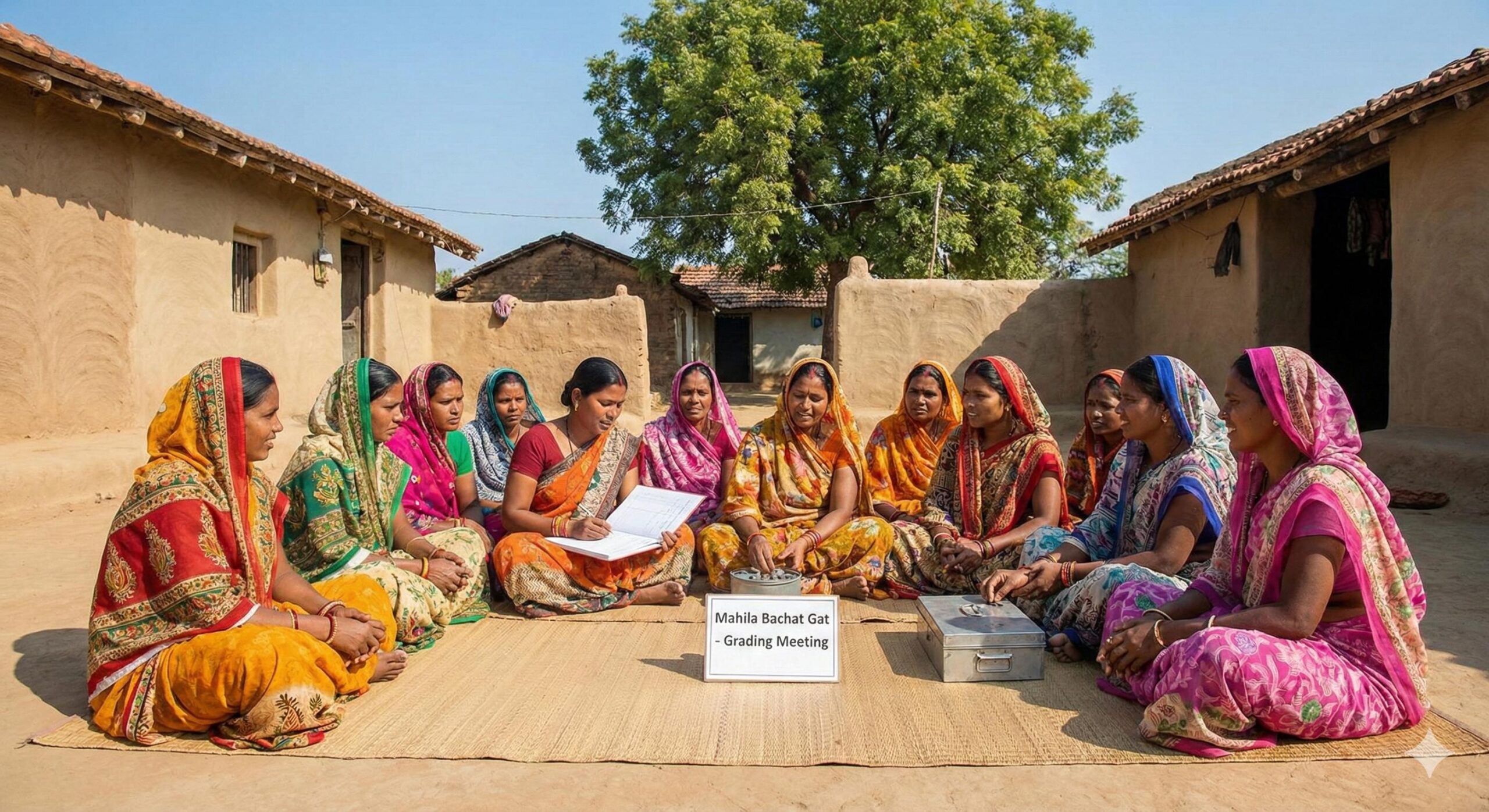
In the rural and semi-urban parts of India, the SHG movement has been extremely helpful to millions of families. From the beginning, women of every caste and religion have started the practice of saving (“Bachat”) as a group, where they contribute a small amount (often only about ₹10 or ₹20 a week) to create a financial cushion for their families. Although this brings a sense of security to the family, it does not result in economic empowerment as the savings cannot be used to fund a business, buy a goat, or continue to send children to school. To achieve this goal, one will have to take out a loan from a bank.
This brings us to the next problem. Banks do not give out loans for no reason. Just like an individual trust score is necessary to take out a personal loan, a self-help group needs to have a good score on a certain evaluation in order to qualify for a bank loan. This evaluation is referred to as SHG grading for bank loans.
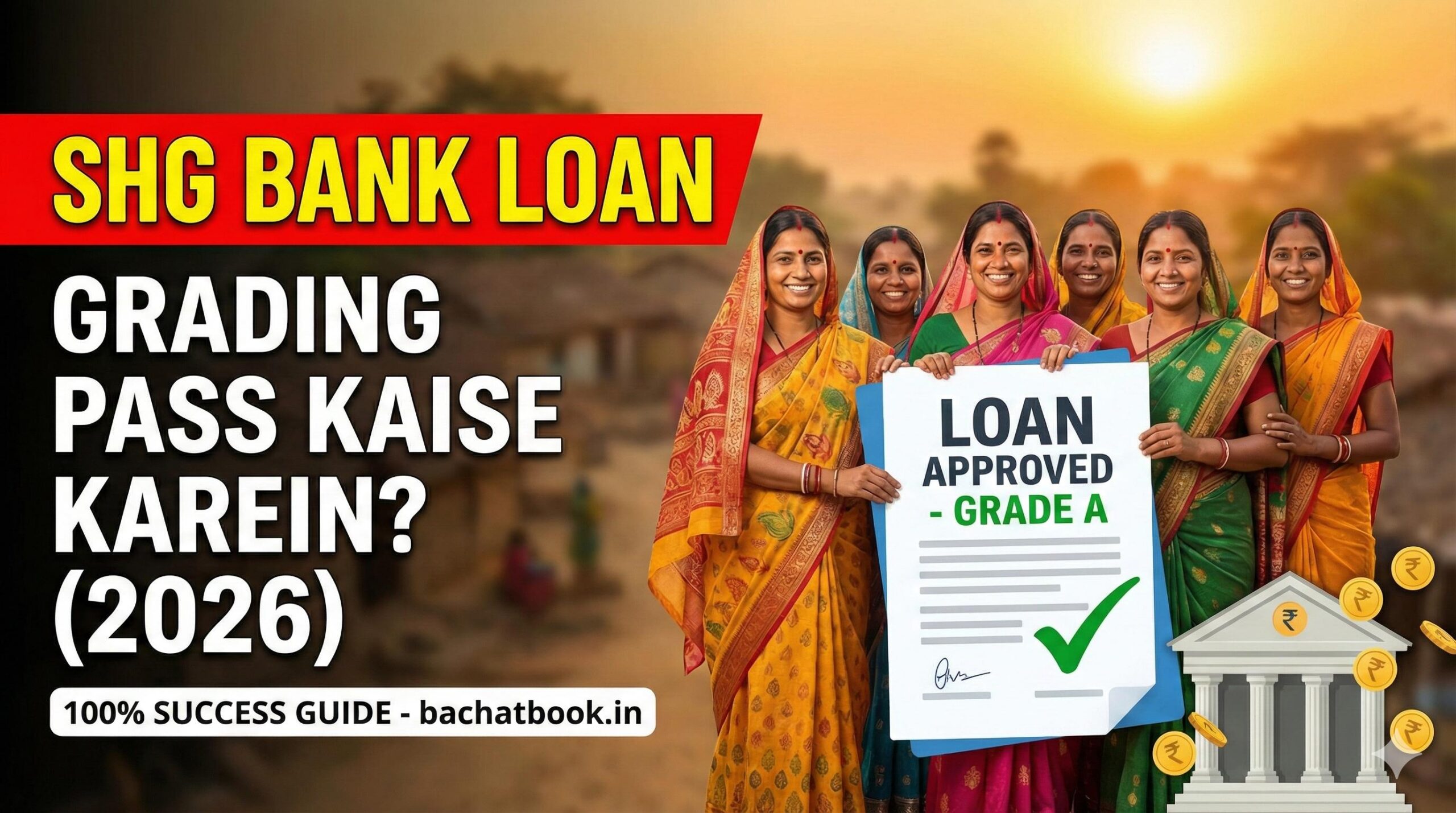
The grading process is shrouded in mystery for most group leaders and members. Why are some groups able to obtain loans of ₹5 Lakhs with little to no effort while other groups are fighting for loans of ₹50,000? The answer is in the grading score. Regardless of whether you are a committed SHG member, a Bookkeeper (Samuh Sakhi), or a rural development student, this guide will clarify the entire grading process. We will analyze the criteria that the banks consider, the metrics that are used to score groups, and how your group can achieve an ‘A’ grade by the year 2026.
Disclaimer: This content is for educational purposes only. It is not professional financial advice. Loan sanctions are subject to bank policies and RBI guidelines.
Table of Contents
What is SHG Grading?
The SHG grading process carried out for obtaining bank loans is not a mere formality. It constitutes a detailed health check-up of the group. When a group of 10 to 20 women come together, they are, in essence, establishing a “mini-bank.” Before a commercial bank (like SBI, PNB, or a Regional Rural Bank) provides any form of external funding to this mini-bank, they must be confident that the group is stable, democratic, and financially responsible.
The grading process is one of the ways to establish the group’s “creditworthiness.” It examines the group across a range of criteria such as attendance, savings, and lending (both internal and external), record-keeping, and overall meeting structure and flow. It converts the group’s social capital into a score, typically out of 100 or 150.
Consider it a quality check or sort. A good grading score conveys to a bank manager, “This group is good. They will take care of their money, and they will take care of the bank’s money too.” Without this, grading many SHGs would continue to be only savings clubs, disconnected from the larger, more formal financial system of India.
Why is Grading Important for Bank Loans?
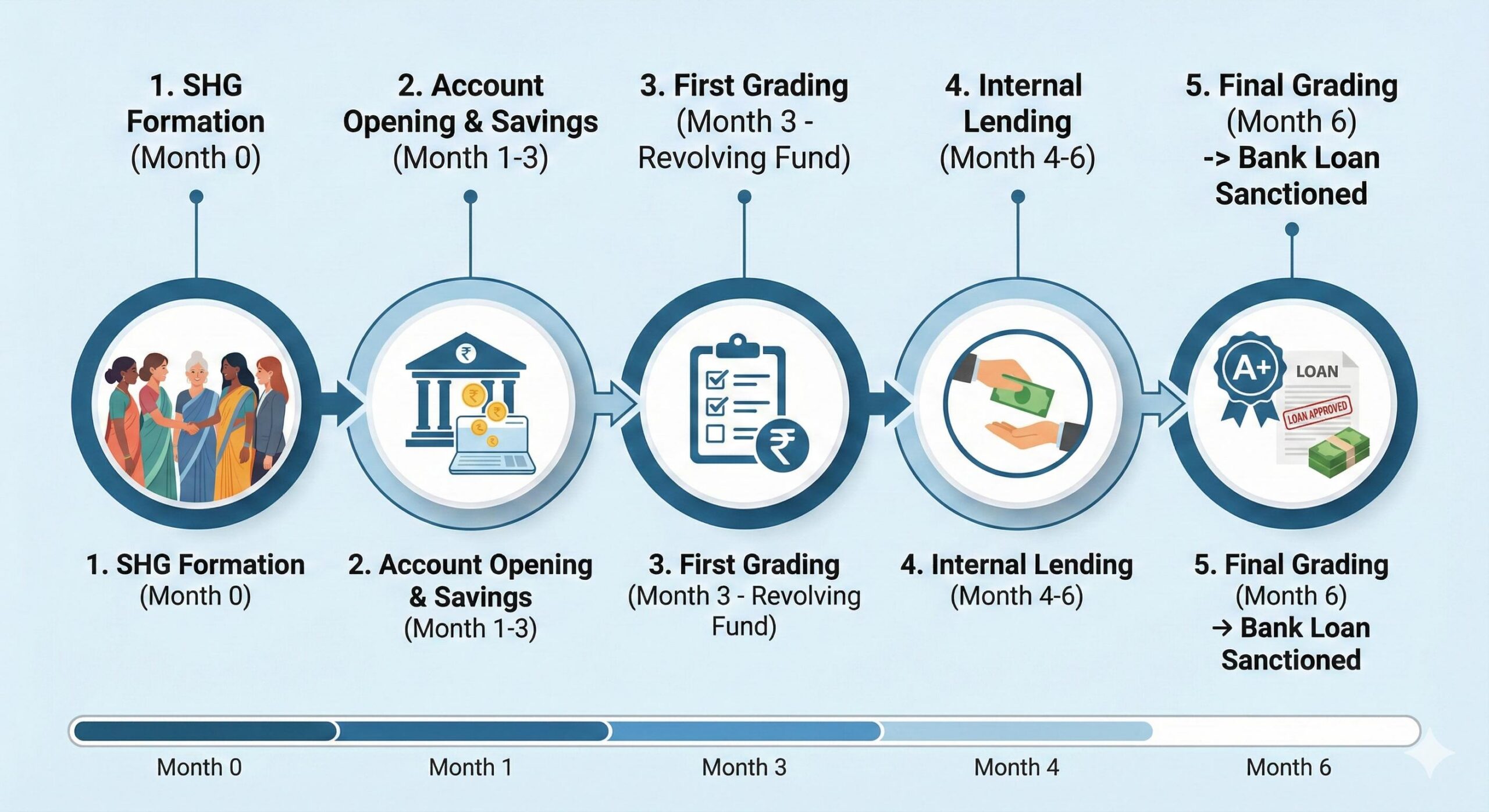
It is essential that every member grasp the “why.” Grading is not merely a formality to “get through” an exam; it creates a number of financial opportunities for the group under the Deendayal Antyodaya Yojana-National Rural Livelihoods Mission scheme (DAY-NRLM).
Eligibility for Credit Linkage
The first advantage is that members of the group can access credit facilities. As part of the risk-sharing features offered to banks, they are required to lend to SHGs. However, they have to lend while protecting the money of the depositors. An evaluative grading exercise acts as the screening mechanism. Only groups that clear this exercise (commonly above 70% or 80% score) qualify for the first series of bank financing, termed the ‘First Linkage.’
Determining the Loan Amount (Corpus Ratio)
The amount of money awarded to the group is influenced by their score. The banks use something called a “Corpus to Loan Ratio” to determine the limit.
- Average Grade: Can usually obtain a loan that is equal to 1 or 2 times their total savings (Corpus).
- Excellent Grade: Can usually obtain a loan that is 4 to 6 times their total savings. So a better grade actually means more money that can be invested into the group members’ livlihoods.
Access to Revolving Fund (RF)
Prior to the large bank loan, new groups qualify for a “Revolving Fund” (RF)—a one-time, government or project authority funded grant in the range of ₹10,000 to ₹15,000 to initiate the group’s internal lending. Grading is the compulsory action to disburse this grant.
Interest Subvention Benefits
Groups that perform well and sustain good grades and on-time repayments are able to access what is known as “Interest Subvention.” They get the benefit of the government subsidizing some of the interest they pay as a group (this can mean an effective interest rate of 7% and in some states even 4%). With the potential of saving so much money, a poor grade can mean being ineligible to access these benefits.
The Panchasutra: The Foundation of Grading
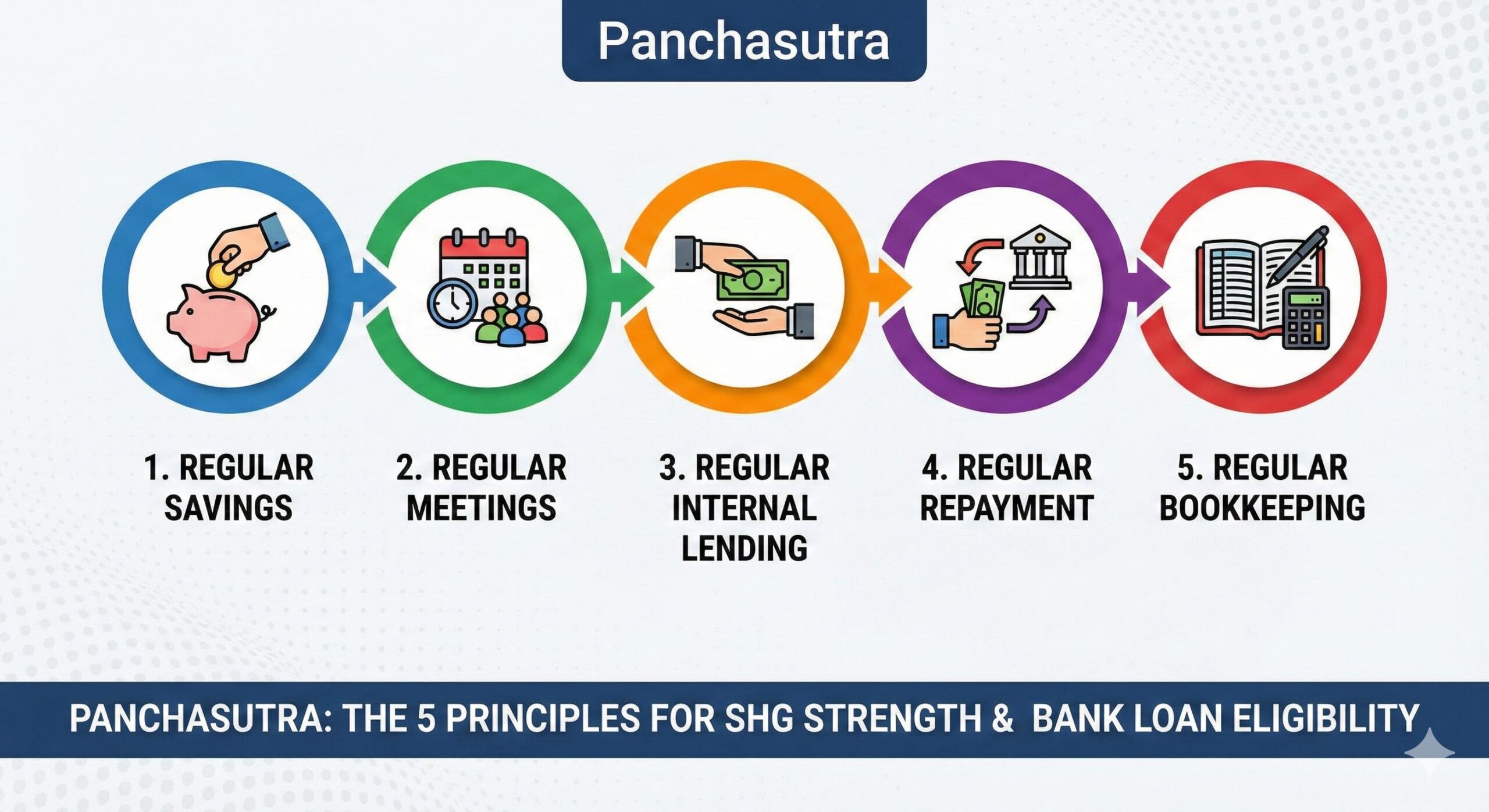
If there’s one thing you should remember from this guide, it should be the “Panchasutra” (Five Principles). These are the five principles that provide the foundation to the entire SHG grading for bank loan system. These five habits are given maximum weightage by NABARD (National Bank for Agriculture and Rural Development) and all other major banks.
1. Regular Meetings
The group must meet at a fixed frequency—usually weekly or fortnightly. The meeting should happen at a specific time and place. This proves the group’s social cohesion. If members only meet when they need money, it is not a “Self-Help Group”; it is just a crowd.
2. Regular Savings
Groups tend to compete with one another, and the winners typically pocket the larger savings. Banking is more interested in groups that exercise regular savings discipline compared to those with higher savings that are saved in an undisciplined manner. For example, a group with a regular savings discipline of ₹10 would win over a group with a savings average of ₹100.
3. Regular Inter-loaning
Banks compete with uncontrolled access. Idol groups with savings that remain in the group account without rolling in loans to members fail to perform; they lack loan rotations. There are many valid reasons for obtaining an internal loan; it’s essential that money ‘rolls’ in the group for all.
4. Regular Repayment
Repayment from internal loans is a proper indicator of loan repayment from banking services. If members do not trust the group’s internal savings, banks are interested in this loss of trust. Members with a high equity loan repayment also score the highest with banks.
5. Regular Book-keeping
All receipts and loans issued must be recorded without delay. The Five Books of Records (Minute Book, Savings Ledger, Loan Ledger, Cash Book, and General Ledger) must be updated at the meeting. The later they are updated, the less trust your members will have.
Detailed Parameters of SHG Grading (Scorecard)
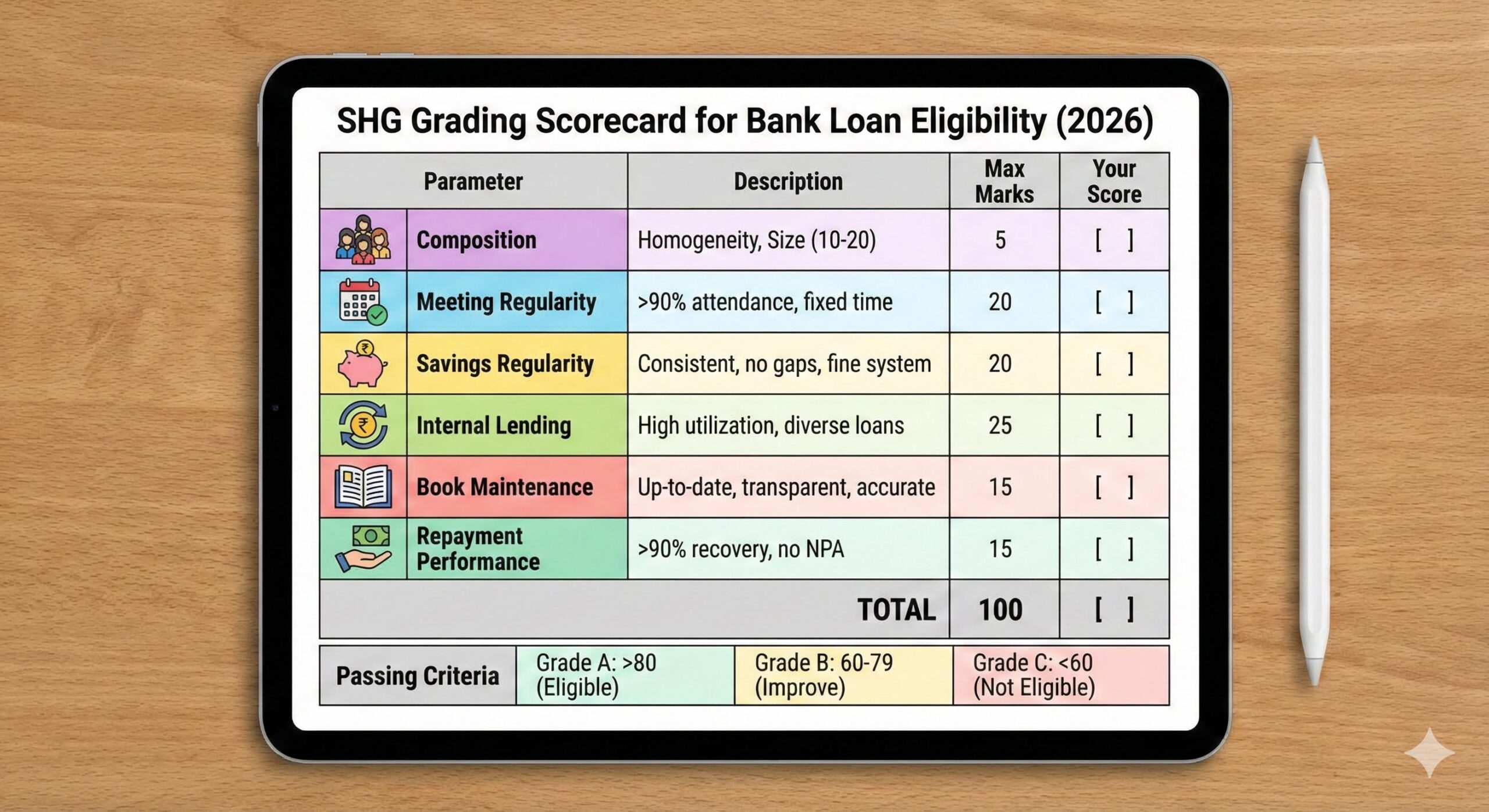
Every time evaluators from the Bank or the Cluster Coordinator visit your group, they have a checklist. Although specific scores may differ from bank to bank, the rationale is consistent. Below is a sample breakdown of the typical 100-mark scorecard for the year 2026.
Composition of the Group (Weightage: ~5 Marks)
- Homogeneity: The bank assesses the members’ socio-economic standing. Groups with a mix of very rich and very poor members tend to fail as the rich members may dominate the decision making.
- Size: The optimal size is between 10 to 20 members. Groups larger than 20 become unmanageable and groups less than 10 are viewed as unstable.
- Background: Groups consisting of members from Below Poverty Line (BPL) families are given higher preference.
Regularity of Meetings (Weightage: ~15-20 Marks)
- Attendance Register: The officer will check the number of signatures. If the average attendance is above 90%, everyone gets full marks. If the average is below 70%, marks are lost heavily.
- Minutes:Are the minutes of the meeting well done? Do they show what was decided?
Regularity of Savings (Weightage: ~20 Marks)
- No Gaps: The officer looks for gaps in savings. If a member did not save in January and was double in February, this is still a negative mark. You have to be consistent.
- Fine System:Does the group have a fine for late savings? The mere existence of a punishment system indicates that the group is serious about its regulations.
Regularity of Internal Lending (Weightage: ~20-25 Marks)
- Credit Utilization Ratio: This key technical term gives the percentage of the group total savings that is currently out as loans.
- Example: If Total Savings = ₹1,00,000 and Loans Outstanding = ₹90,000, the ratio is 90%. This is gets excellent marks.
- If Loans Outstanding = ₹10,000, the ratio is 10%. This gets poor marks because the money is idle.
- Diversity of Loans: Are loans given for consumption (food, health) as well as production (buying a cow, opening a shop)? Banks prefer a mix.
Maintenance of Books (Weightage: ~15 Marks)
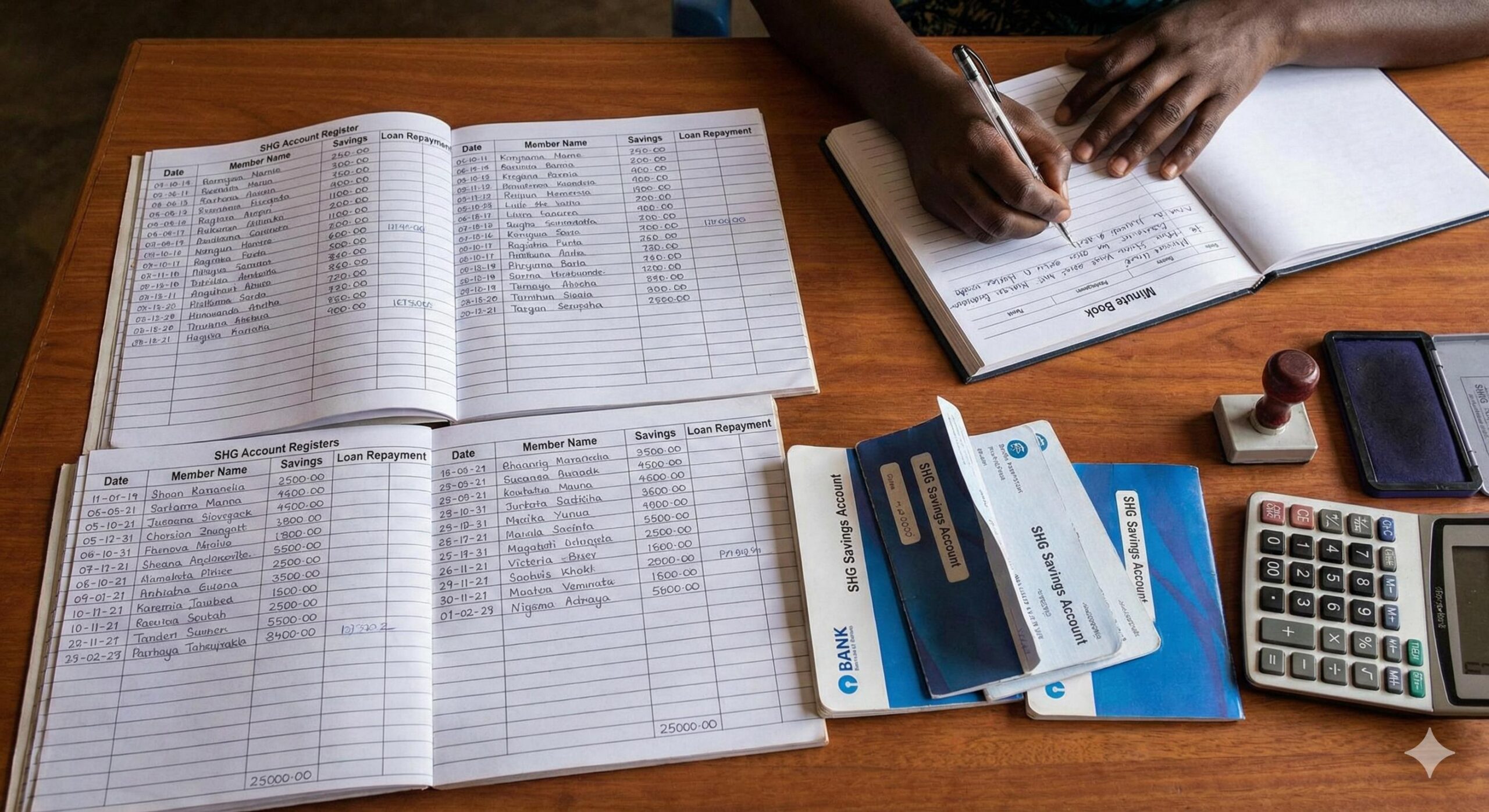
- Clarity and Accuracy: Are there too many scratch-outs or overwrite? Are the totals correct?
- Member Awareness: The officer may randomly ask a member, “What is your total saving?” If the member is able to answer, that means the books are clear and have been discussed during the meetings.
Repayment Performance (Weightage: ~15-20 Marks)
- Recovery Percentage: The bank calculates the percentage of loans recovered against the demand.
- Recovery > 90% = Excellent marks.
- Recovery < 80% = The group enters the “Risk Zone.”
- NPA Check: Even if one member has defaulted and the group hasn’t taken action, the whole group’s score suffers.
Passing Criteria
- Grade A (80-100 marks): Eligible for full credit linkage and high loan amounts.
- Grade B (60-79 marks): May get a smaller loan or be asked to improve for 3 months.
- Grade C (Below 60 marks): Not eligible for bank loans. Needs intensive training.
Common Reasons SHGs Fail the Grading Test
While some groups do put in effort to access funds, this is often the result of the common oversights that occur before the grading day.
Idle Funds (The “Lazy Money” Problem)
Fright is the leading cause of failure. Because groups are scared to loan money, funds stagnate. Banks think groups are “too rich to need any money,” meaning the group is ineligible to borrow. Groups must internally lend to pass the test.
Poor Record Keeping (The “Memory” Problem)
A common issue with groups is that they manage their finances informally. In banking circles, this is a recipe for failure. If the Minute Book is not clear, any decisions made in a meeting, even unanimous ones, do not exist. Registers that are incomplete, in other words, not kept at all, leads to failure.
The “One-Woman Show”
If either the President or the Secretary is the only active participant in a grading meeting then the group is likely to be penalized for “absence of participatory democracy.” Banks are likely to collapse should the group’s leadership leave.
Irregular Attendance (The “Proxy” Problem)
An easily recognizable “proxy” attendance case is when parents are sent to pay savings or sign for absentees. Such behavior shows that members are losing interest in the group dynamics.
Step-by-Step Process to Improve Your Grading Score
If your group is preparing for a loan application, don’t let the bank officer catch you. Follow this checklist for a sure ’A’ grade.
Step 1: Conduct a Mock Grading
A month before the application, schedule a special meeting. Use the scorecard above to grade yourselves. Be very honest and identify the weak points. Is there very low attendance? Is there a member who is not paying back?
Step 2: Update the Books Immediately
If needed, employ a professional Bookkeeper (Samuh Sakhi) but do all you can to get all 5 registers current. Make sure to get all the members in the Attendance Register.
Step 3: Rotate the Idle Cash
Look in your cashbox and in the bank to see if you have excess cash. You can loan a small amount, even as low as ₹500, for household purposes. The “Velocity of Internal Lending” will be improved.
Step 4: Member Education
Train every member to answer three basic questions:
- How much have I saved?
- How much loan have I taken?
- What is the interest rate of our group? When every member knows these answers, the grading officer is impressed.
Step 5: Regularize Defaults
Each member of the group should help their peer clear the payment due before the end of the grading period. The group should help the peer clear their excuse before the grading period. The group will take a lot of time to have a cleaning period excuse to help the excuse before the end. It’s the strongest anchor.
The Role of Digital Tools in SHG Grading
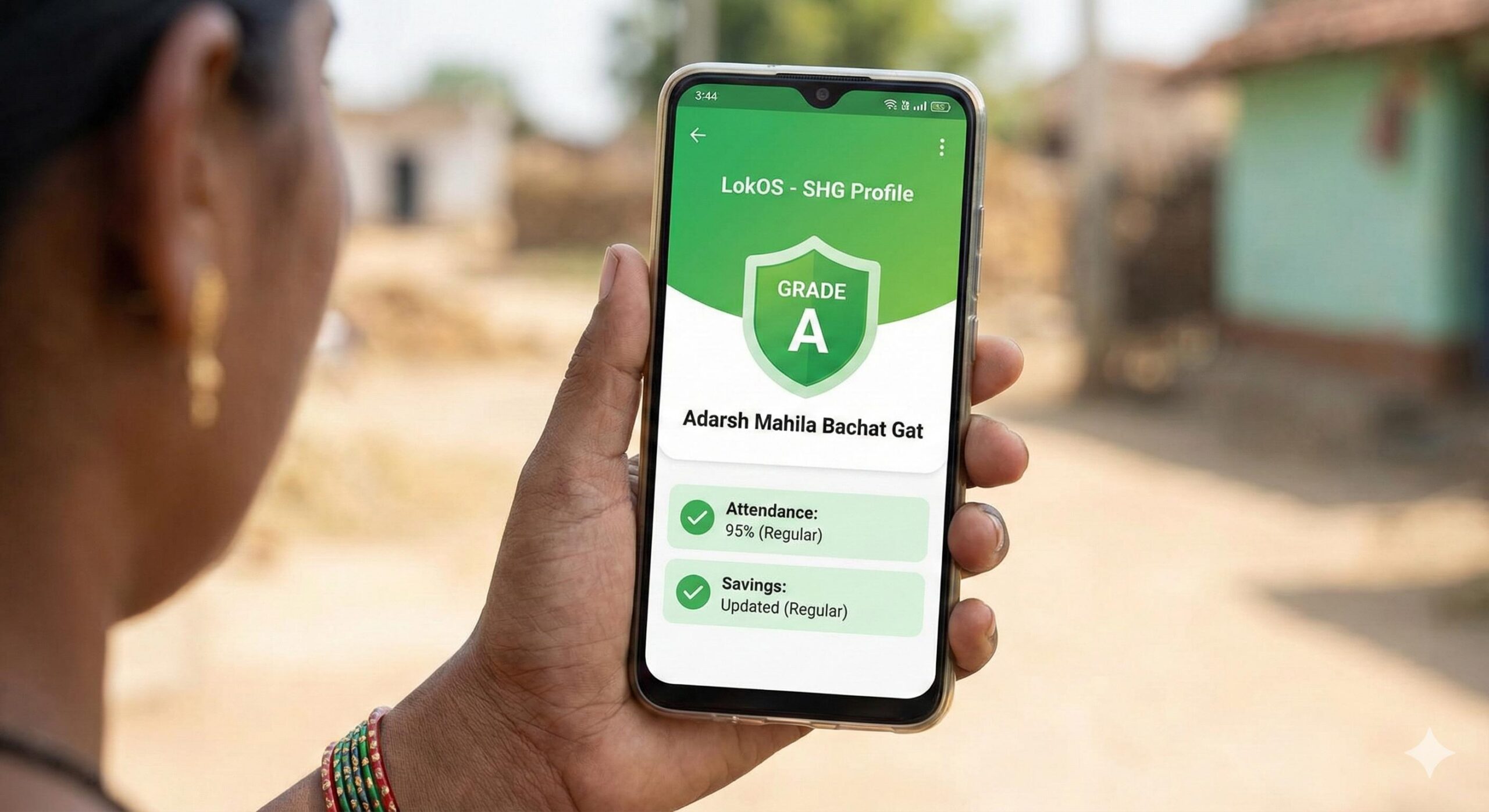
In 2026, the era of handwritten registers is slowly fading. The Government of India is aggressively digitizing SHG records to bring transparency and speed to the grading process.
LokOS and E-Shakti
The NRLM’s LokOS app and NABARD’s E-Shakti app are changing how grading is done. Community Resource Persons (CRPs) input data on savings, attendance, and loans into tablets. Now, banks can access an SHG’s “Health Card” online without going to the village. Groups that keep their digital data up to date receive “Instant Grading” and quick loan approvals.
Credit Scoring Algorithms
The SHG grading scores are supplemented by new FinTech tools that use alternative data such as consistency in and payment of mobile and electric bills. This aids groups with thin files in obtaining access to credit.
SMS Alerts
With transparency in mind, modern SHG accounts with digital services integrated send an SMS alert to all office bearers whenever a transaction occurs. These groups are rewarded in the “Governance” and “Transparency” categories.
Long-Term Benefits of Good Grading
Considering the SHG grading for bank loans as an obstacle would be shortsighted. A favorable grade provides ample benefits in addition to loan approval.
Higher Loan Limits (CIF and Bank Linkage)
An ‘A’ Grade group today can access ₹1 Lakh. If they repay well and maintain the grade, the next cycle could be ₹3 Lakhs, then ₹5 Lakhs, and eventually up to ₹20 Lakhs. This capital can transform a small vegetable vendor into a wholesale distributor.
Graduation to Producer Groups
Starting from the high grading, there is the option of forming “Producer Groups” or “Farmer Producer Organizations” (FPOs). This enables members to collectively sell their products (such as milk, grains, or handicrafts) in larger markets for a better price.
Social Capital and Respect
Within the village ecosystem, an ‘A’ Grade SHG is regarded with respect. They are viewed as responsible and well-organized individuals, and as such, they are often prioritized for other government benefits such as the Pradhan Mantri Awas Yojana (Housing) or insurance schemes.
SHG Bank Linkage Scheme 2026: New Loan Limits, Interest Rates & Eligibility Guide
Frequently Asked Questions (FAQs)
How long does an SHG need to be around to get graded? Generally an SHG will need to be around for 6 months before they can get graded for principal Credit Linkage grading, but for an initial Revolving Fund (RF) grading, 3 months is usually good enough.
Who is responsible for grading SHGs? Typically, grading is done by the Field Officer or the Branch Manager of the bank. In several states, they are supported by the staff of the State Rural Livelihood Mission (SRLM) or other NGOs whom they consider facilitators.
How much grading is needed to get a bank loan? The grading Gold standard is 80% (Grade A) but banks vary policy so to be graded at 60-79% (Grade B) banks typically consider the group for an improvement on a number of items in 3-6 months before a reconsideration.
Does SHG grading impact my individual credit score? Yes, but indirectly. Group loans operate on “joint liability” whereby if the group fails to pay the loan, it could potentially be classified as an unpaid loan on the individual credit reports of the members and office bearers. This could hinder your ability to obtain personal loans in the future.
Can a defaulted group apply for grading again? Yes, it is possible. A group that has defaulted, or failed, can pursue a process called “revival.” After complete payment of previous dues, regular meetings, and six months of new discipline, a group can apply for new grading.
Is the grading process same for all banks (SBI, PNB, Regional Rural Banks)? While the core “Panchasutra” principles remain the same, as per RBI and NABARD guidelines, the particular structure of the scoresheet and some other aspects differ from bank to bank. For instance, the total number of marks could be 100 in some banks and 150 in others.
Conclusion
The journey to financial freedom for Indian families, is a journey that can start from a small, shared, collective effort. The SHG grading for bank loan is a process that captures and channels this effort on the right path. It does not prevent the poor from accessing money, but it protects them by ensuring that they can handle the money they receive.With an emphasis on meeting regularly, saving consistently, lending to each other, and repaying on time, any group can pass this grading test very easily. Always keep in mind, the purpose of bachat in a group is not merely to gather a certain amount of money, rather to develop a strong enough discipline to unlock bigger financial opportunities towards fulfilling your life aspirations.