

Introduction: Empowering Your Business with the Right Start
In the journey of entrepreneurship, capital is the fuel that keeps the engine running. For many small business owners in India—whether you are running a small grocery store, a tailoring unit, or a startup—accessing formal credit has traditionally been a challenge. The Pradhan Mantri Mudra Yojana (PMMY) was launched to bridge this gap, providing collateral-free loans to the “unfunded” sections of society.
However, the first hurdle many face is the paperwork. Understanding Mudra loan form kaise bhare is not just about filling in boxes; it is about presenting your business vision to the bank in a way that demonstrates responsibility and growth potential. This guide will walk you through the entire process, from selecting the right category to protecting your financial identity from scammers.

Disclaimer: This article is for educational purposes only and does not constitute professional financial advice. For specific loan terms, interest rates, and eligibility, please consult with your bank manager or a certified financial advisor.
Table of Contents
Understanding the PM Mudra Yojana Categories
Before you pick up the pen to fill out the form, you must identify which “stage” your business falls into. The Pradhan Mantri Mudra Yojana (PMMY) is divided into three tiers based on the funding requirement:
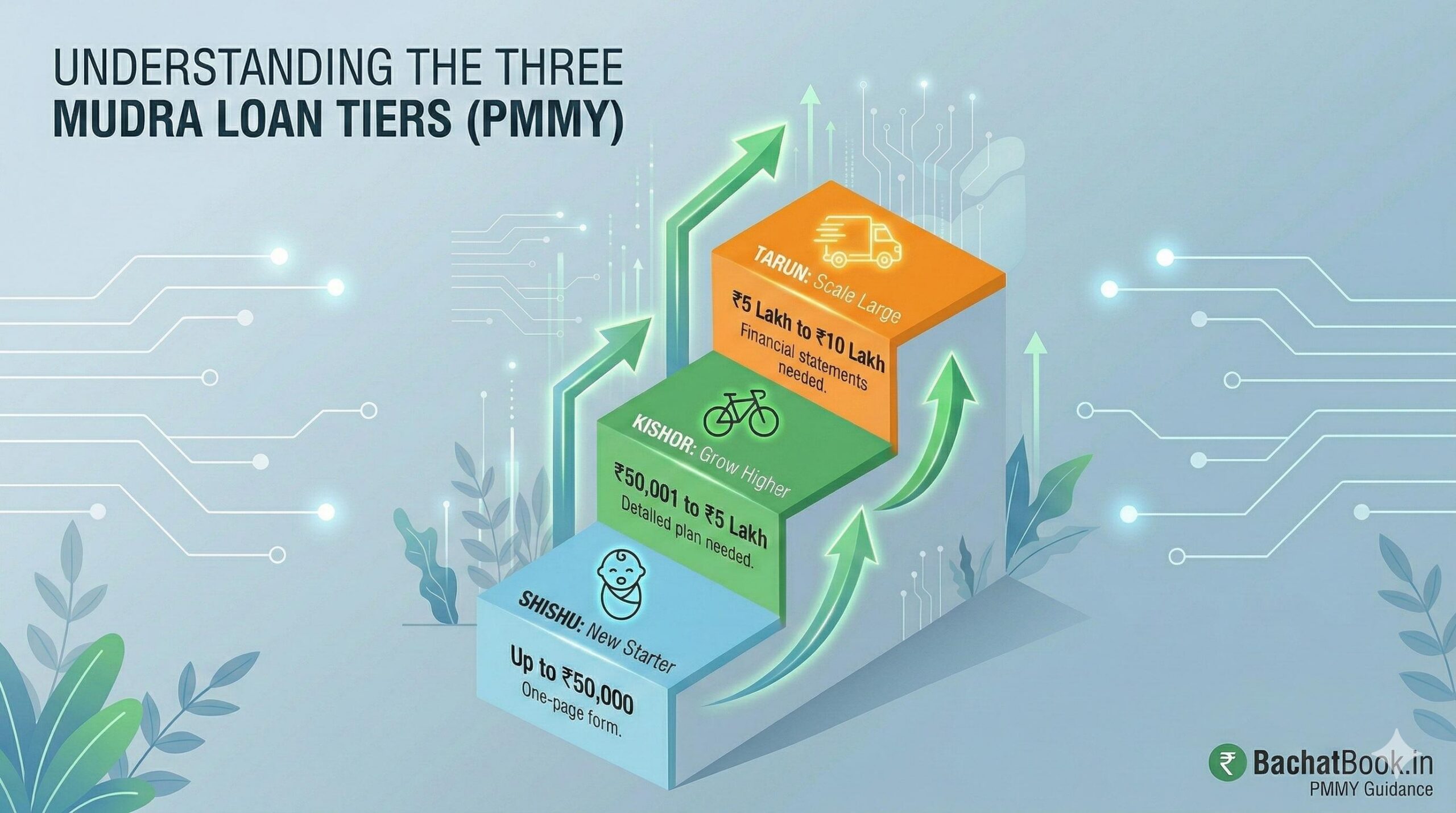
- Shishu Loan: This is for entrepreneurs who are either in the starting stage or need a small amount of capital. The limit is up to ₹50,000. The form for this is the least complex.
- Kishor Loan: Aimed at businesses that have already started and want to expand. The loan amount ranges from ₹50,001 to ₹5 lakh.
- Tarun Loan: This is for established small businesses that require higher capital for significant growth. The limit is from ₹5 lakh to ₹10 lakh.
Choosing the right category ensures that your application is processed under the correct guidelines and increases your chances of approval without unnecessary delays.
Mudra Loan Form Kaise Bhare: A Detailed Walkthrough
Filling out the form requires precision. Any mismatch in data can lead to rejection or, worse, make you vulnerable to “agents” who claim they can “fix” your application for a fee.
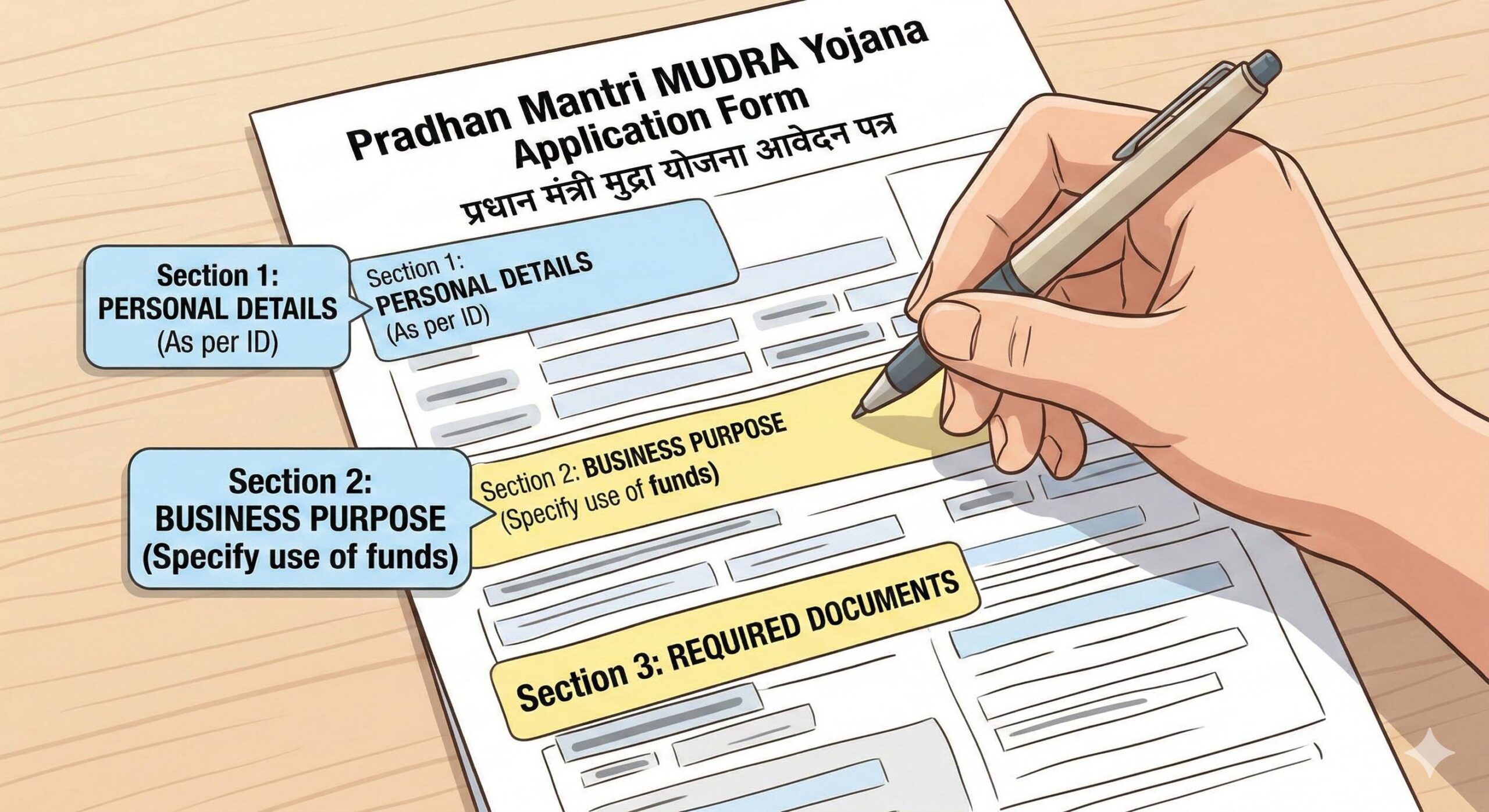
1. Personal and Business Details
In the first section, you will enter the name of the applicant and the proposed name of the business. Use your official name as per your Aadhar card. If you are a sole proprietor, your name and the business name might be the same or different depending on your registration.
2. Contact Information
Provide a permanent address and a business address. If you are running a shop from a rented space, ensure you have a rent agreement, as this will be required as proof.
3. Category and Social Background
The form asks for your social category (General, SC/ST, OBC, or Minority). This is for statistical purposes and to ensure the scheme reaches all sections of society as intended by the government.
4. Purpose of the Loan
This is a critical section. You must clearly state why you need the money. Are you buying a sewing machine? A delivery bike? Inventory for a Kirana store? Be specific. Instead of writing “for business,” write “to purchase a refrigerator for a dairy shop.”
5. Existing Credit Facilities
If you already have a loan from another bank, you must disclose it. Hiding existing debt is a major red flag for banks and can lead to immediate rejection during the CIBIL check.
The Risk Factor: Protecting Yourself During the Application Process
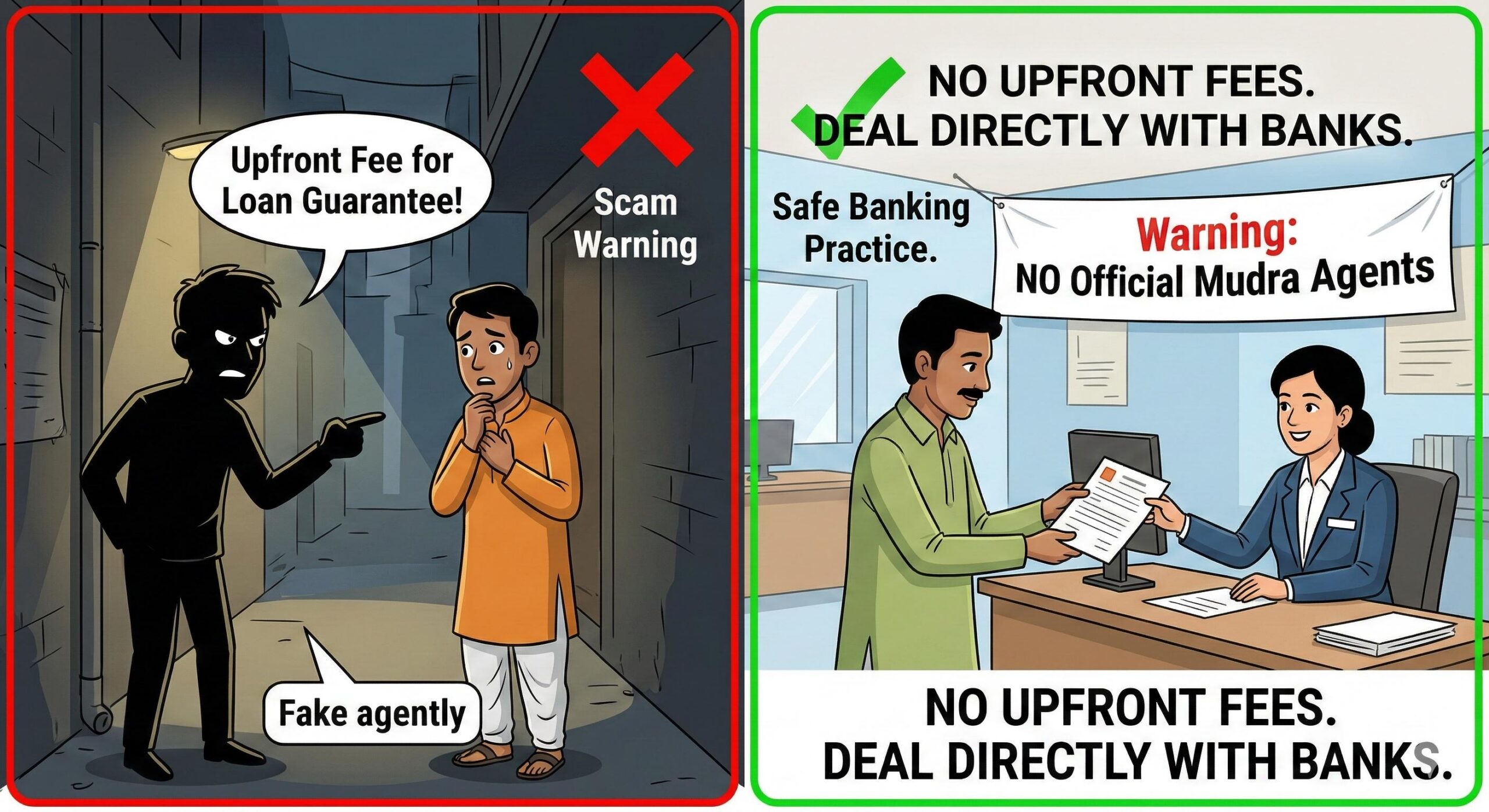
While the Mudra loan is a legitimate government initiative, the popularity of the scheme has unfortunately attracted fraudsters. Financial awareness is your best defense.
The “Processing Fee” Scam One of the most common risks is encountering individuals who pose as “Mudra Loan Agents.” They may tell you that the “Mudra loan form kaise bhare” process is too difficult for a common person and offer to do it for you in exchange for an upfront “file charge” or “GST fee.”
The Reality:
- There is no processing fee for Shishu loans.
- The government does not appoint private agents to sanction Mudra loans.
- Legitimate banks will never ask you to transfer money to a personal account to “guarantee” a loan.
If someone asks for money to approve your loan, it is almost certainly a scam. Always deal directly with the bank branch or use the official government portals.
Financial Impact: The Weight of a Loan
Taking a loan is a serious financial commitment. Even a small Shishu loan of ₹30,000 carries an obligation. When you fill out the Mudra form, you are essentially making a promise to the banking system.
Impact on Credit Score (CIBIL): Even though Mudra loans are “collateral-free” (meaning you don’t have to give your house or gold as security), they are still reported to credit bureaus. If you fail to pay the EMIs on time, your CIBIL score will drop. A low credit score can prevent you from getting a home loan, an education loan for your children, or an emergency personal loan in the future.
Debt Trap Risk: Using loan money for personal expenses instead of business growth is a recipe for disaster. If the money doesn’t generate profit, paying the interest becomes a burden on your household budget, leading to a cycle of debt.
Prevention Habits: How to Stay Financially Safe
To ensure that your journey from “filling the form” to “growing the business” is successful, adopt these preventive habits:
- Verify the Source: Only download the Mudra loan form from official bank websites or the official PMMY portal. Avoid clicking on links sent via SMS or WhatsApp that claim “Mudra Loan Approved – Click here.”
- Keep Documents Ready: Ensure your Aadhar is linked to your mobile number. This makes the e-KYC process seamless and prevents others from impersonating you.
- Read Before Signing: Never sign a blank form. Ensure all columns are filled by you or in your presence.
- Documentation Hygiene: Keep a photocopy of the filled form and the acknowledgement receipt provided by the bank. This is your proof of application.
Smart Money Behavior for Small Entrepreneurs
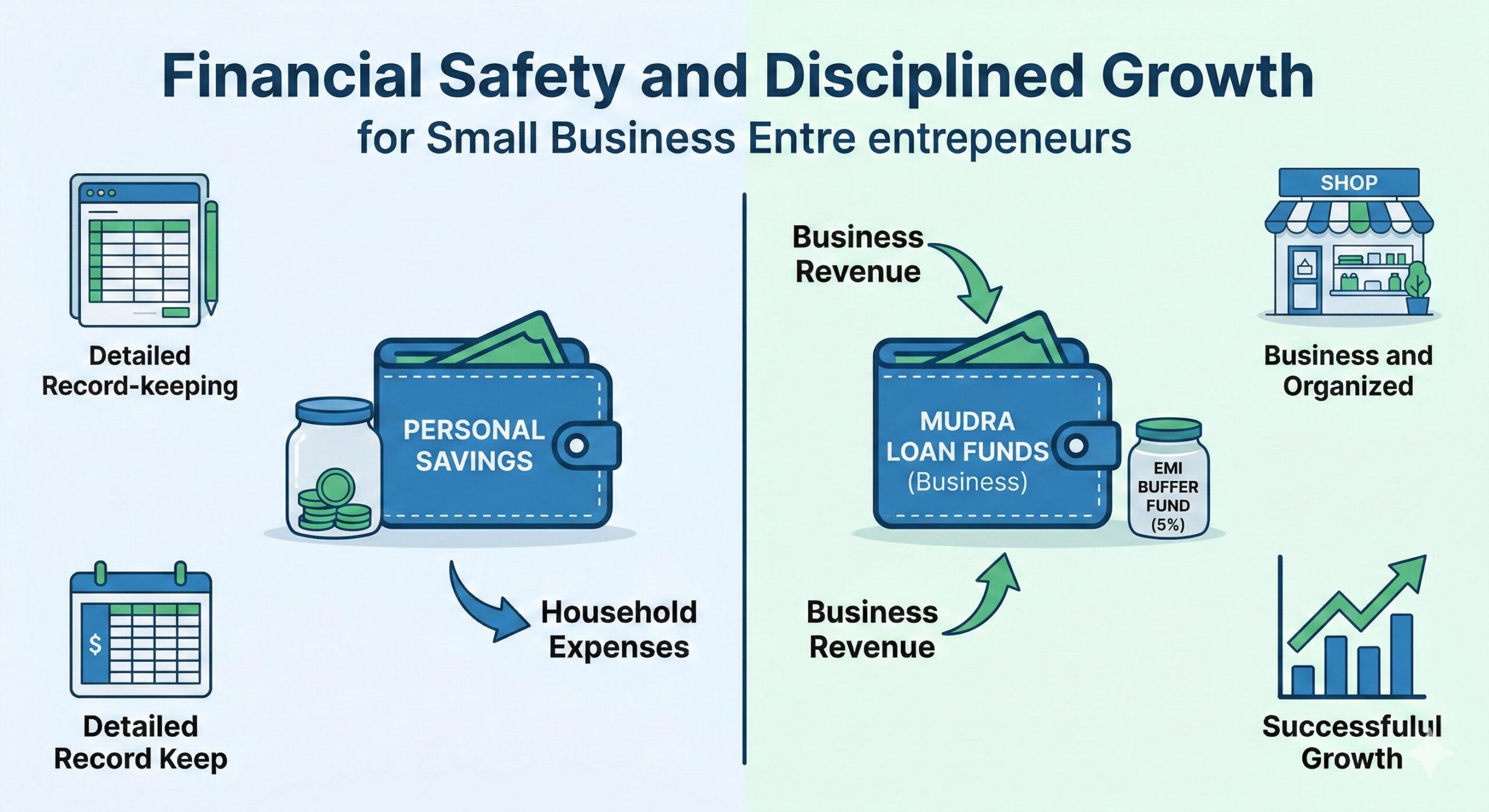
Success in business isn’t just about getting the loan; it’s about how you manage it. Smart money behavior separates a struggling shopkeeper from a successful entrepreneur.
1. Separate Business and Personal Wallets Keep your loan money in a separate bank account if possible. When you buy supplies for your business, use that account. Do not use the Mudra loan funds to pay for household electricity bills or school fees.
2. The 5% Buffer Rule Always try to keep at least 5% of your loan amount as a small emergency reserve. If your business has a slow month, this buffer will help you pay your EMI on time, keeping your financial reputation intact.
3. Digital Record Keeping Even if your business is small, keep a diary or use a simple mobile app to track daily sales. This data will be incredibly helpful if you decide to apply for a “Kishor” or “Tarun” loan later, as banks love to see organized records.
4. Understand Interest Rates Mudra loans do not have a fixed interest rate; it varies from bank to bank but is generally linked to the MCLR (Marginal Cost of Funds Based Lending Rate). Always ask the bank manager, “What is the final interest rate I will be paying?” before accepting the funds.
Step-by-Step Summary Table
| Step | Action | Detail |
| Step 1 | Identify Category | Choose Shishu, Kishor, or Tarun based on amount. |
| Step 2 | Gather Documents | Aadhar, PAN, Address Proof, Business Proof, Photos. |
| Step 3 | Download Form | Visit mudra.org.in or your bank’s site. |
| Step 4 | Fill Details | Name, Business Type, Required Amount, Purpose. |
| Step 5 | Submit | Hand over to the Branch Manager of a nearby bank. |
| Step 6 | Follow Up | Get an application tracking number or receipt. |
Final Thoughts on Financial Discipline
Learning Mudra loan form kaise bhare is the doorway to self-reliance (Atmanirbharta). However, the money you receive is a tool, not a gift. It is the hard-earned money of depositors in the banking system, and using it wisely is a civic and financial responsibility.
By staying alert to frauds, maintaining a clean repayment record, and practicing disciplined spending, you can use the Mudra scheme to build a secure future for your family. Remember, a loan is a bridge to your dreams, but only if you build it on the solid foundation of financial awareness.
Understanding a Business Loan Bina Security Ke (2026)
Frequently Asked Questions (FAQ)
1. Mudra loan form online kaise bhare?
You can apply online through the Udyamimitra portal (udyamimitra.in). You will need to register, choose the ‘Mudra Loan’ option, upload your digital documents (Aadhar, PAN, Business Proof), and select your preferred bank. The digital process is often faster and more transparent.
2. What documents are required for a Shishu Mudra loan?
For the Shishu category (up to ₹50,000), you generally need:
- Identity Proof (Aadhar/Voter ID/PAN)
- Address Proof (Voter ID/Electricity Bill)
- Recent Passport size photographs
- Quotation for the machinery or items you wish to purchase
- Proof of business identity (if existing)
3. Is a guarantor or collateral (security) required for a Mudra loan?
No. According to RBI guidelines, Mudra loans are collateral-free. You do not need to provide land papers, gold, or a third-party guarantee to avail of this loan. The credit is backed by the Credit Guarantee Fund for Micro Units (CGFMU).
4. How long does it take for the Mudra loan to be sanctioned?
While it varies by bank, Shishu loans are designed to be processed quickly, often within 7 to 10 working days, provided all documents are in order and the verification is successful.
5. Can I apply for a Mudra loan if I have a low CIBIL score?
While the Mudra scheme aims to help everyone, banks do check your credit history. If you have defaulted on a previous loan, your application might be rejected. However, if you have no credit history (New to Credit), you are still eligible to apply.
Conclusion: Turning a Loan into a Legacy

Filing a Mudra loan application is a significant step toward financial independence. By knowing exactly Mudra loan form kaise bhare, you eliminate the need for middlemen and reduce the risk of falling into “processing fee” traps.
Remember, the goal of this scheme is to help you create a sustainable livelihood. Financial awareness—such as keeping your business and personal expenses separate and maintaining a healthy CIBIL score—is what turns a simple loan into a successful business legacy. Approach this credit with discipline, use it strictly for business growth, and you will find that the banking system becomes a partner in your progress rather than a burden.