
Introduction
In India, every small shopkeeper dreams of turning their small shop into a big showroom. Whether you run a busy Kirana store (grocery shop) in a residential colony, a mobile repair center in the main market, or a garment boutique from home, the ambition is always to grow. However, growth requires fuel, and for a business, that fuel is Capital (Money).
Many shopkeepers have excellent business skills but struggle because of a lack of funds. You might want to stock up on inventory before the Diwali festive rush, renovate your old shop to attract modern customers, or simply manage daily cash flow during a dull season. But when you look at your bank balance, it might not be enough. This is where a business loan becomes a powerful tool.
Unfortunately, the world of banking can feel complicated. Many shopkeepers ask, “Dukan ke liye loan kaise milta hai?” (How to get a loan for a shop?), but they are often scared of heavy paperwork, high-interest rates, or the fear of rejection. They assume that banks only lend to big companies, which is not true.
In this comprehensive educational guide by bachatbook.in, we will demystify the entire lending process. We will explain exactly how to prepare your documents, how to apply for government schemes like the Pradhan Mantri Mudra Yojana, and how to use borrowed money smartly to double your profits.
Table of Contents
Why You Might Need a Shop Loan (Good Debt vs. Bad Debt)
In Indian culture, we are often taught to avoid debt (Udhaar). However, in the business world, successful businessmen know that “money attracts money.” There is a big difference between taking a loan for luxury (Bad Debt) and taking a loan for business growth (Good Debt).
Here are the specific scenarios where taking a shop loan makes financial sense:
- Working Capital Needs: Imagine it is wedding season, and you own a clothing store. You know that if you stock up on designer sarees worth ₹5 Lakhs, you can sell them for ₹8 Lakhs within a month. If you don’t have the cash to buy the stock, you lose that ₹3 Lakhs profit. A “Working Capital Loan” solves this by giving you cash to buy stock, which you repay once the goods are sold.
- Shop Renovation & Interior: Customer psychology is simple: “Jo dikhta hai, wo bikta hai” (What looks good, sells). If your shop is dark, dusty, and has old wooden racks, customers might assume your products are old too. Taking a loan to install glass shelves, air conditioning, better lighting, or a digital signboard can significantly increase footfall and sales.
- Business Expansion: If your current shop is running successfully, you might want to rent the adjacent shop to double your floor space or open a second branch in a newly developing area. A “Term Loan” helps cover the deposit and setup costs for this expansion.
- Equipment Upgrades: A juice shop owner might need a heavy-duty commercial chiller, or a tailor might need a computerized embroidery machine to work faster. These machines are expensive but increase your daily productivity and income.
- Building Credit History: If you have never taken a loan, you have “No Credit History.” Taking a small business loan and repaying it on time builds a strong CIBIL score. This helps you get bigger loans (like a home loan) easily in the future.
Why Do Banks Reject Shop Loan Applications?
Before applying, it is critical to understand why banks say “No.” If you know the reasons for rejection, you can fix them beforehand.
- Low CIBIL Score (Credit Score): This is the first thing a bank manager checks. Your CIBIL score (ranging from 300 to 900) is your financial report card. If you have missed credit card payments or EMI payments in the past, your score drops. A score below 700 is considered “High Risk,” and banks may reject your application immediately.
- Lack of Business Proof (Unregistered Business): Many small shops in India operate informally. They don’t have a license or a board. To a bank, if you don’t have paper proof (like Udyam Registration or Shop Act License), your business doesn’t exist. Banks cannot lend to “ghost” businesses.
- “Kaccha” Accounts (No Bank Transactions): This is the most common mistake. Shopkeepers collect cash from customers and put it directly into their pocket or home locker (Galla). They pay suppliers in cash too. As a result, their bank passbook shows zero activity. Banks determine your loan eligibility based on the money hitting your bank account. If your bank statement is empty, your loan amount will be zero.
- Too Many Existing Loans (Over-Leveraging): If you already have a personal loan, a bike loan, a gold loan, and high credit card debt, your “Debt-to-Income Ratio” is high. The bank will calculate that after paying all these EMIs, you won’t have enough money left to repay a new shop loan.
Step-by-Step Guide: How to Apply for a Shop Loan
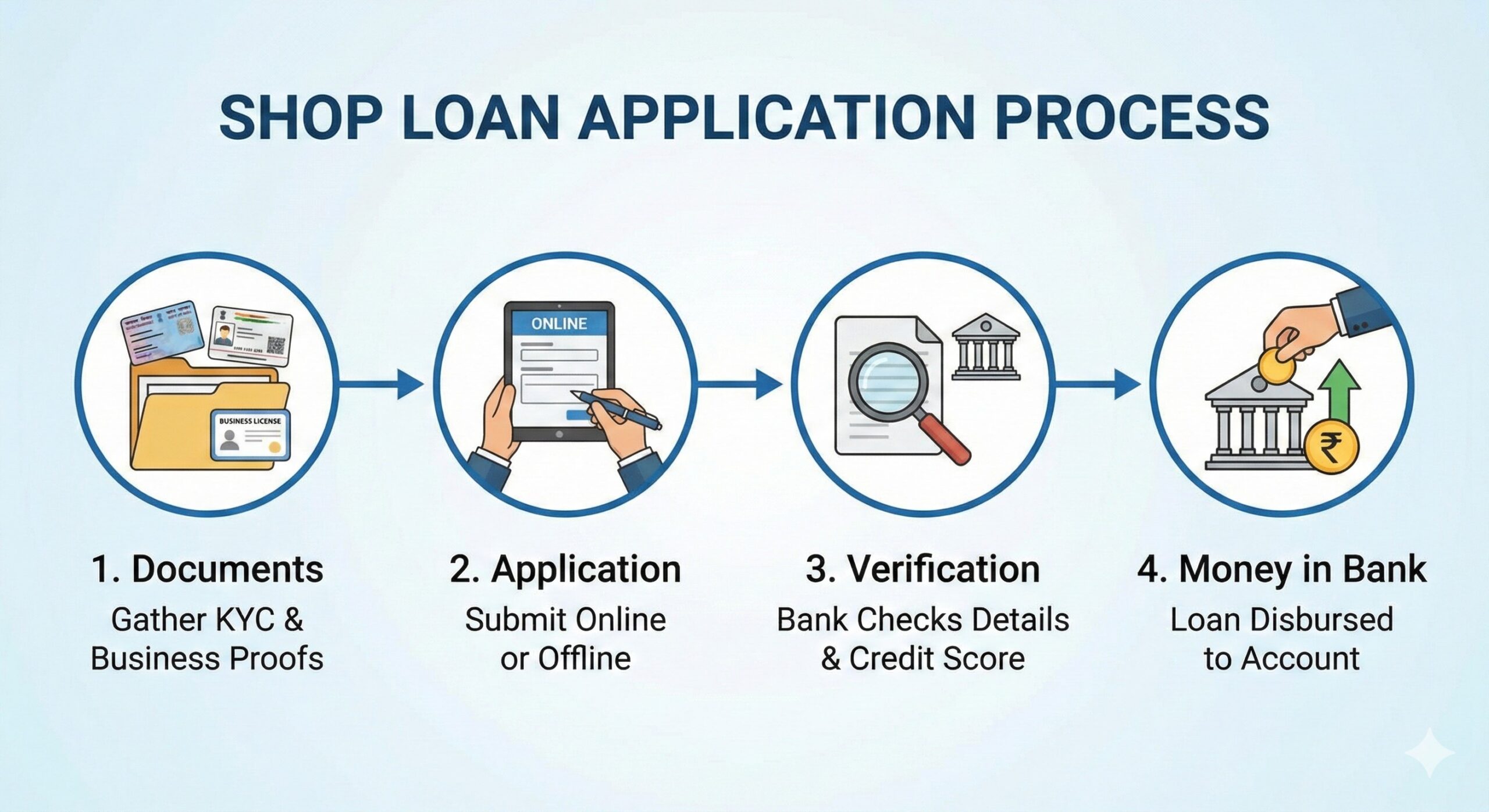
If you are wondering “Dukan ke liye loan kaise milta hai”, follow this systematic roadmap to maximize your chances of approval.
Step 1: Define Your Purpose and Amount Don’t just walk into a bank and ask for “money.” Be specific.
- Bad approach: “I need some money for my shop.”
- Good approach: “I need ₹2 Lakhs to purchase winter inventory for my garment shop.” Banks trust borrowers who have a clear usage plan. Also, calculate the exact amount. Don’t over-borrow, as interest costs will eat into your profits.
Step 2: Choose the Right Type of Loan Provider
- Public Sector Banks (SBI, PNB, Bank of Baroda):
- Pros: Lowest interest rates (8.5% – 11%), transparent processing, government scheme benefits.
- Cons: Strict paperwork, slower processing time (2-4 weeks), requires high compliance.
- Private Banks (HDFC, ICICI, Axis, Kotak):
- Pros: Faster processing (sometimes 48 hours), better customer service, digital application process.
- Cons: Interest rates are slightly higher than government banks, strict checks on turnover.
- NBFCs (Bajaj Finserv, Tata Capital, Aditya Birla):
- Pros: Very fast approval, flexible eligibility (sometimes give loans with lower CIBIL).
- Cons: Highest interest rates (16% – 24% or more).
Step 3: Check Your Eligibility
- Age: Usually, the applicant must be between 21 and 65 years old.
- Business Vintage: Most banks require your shop to be operational for at least 2-3 years. (Note: For startups, you must apply specifically under the Mudra Yojana “Shishu” category, as standard business loans won’t apply).
- Turnover: Some private banks require a minimum annual turnover (sales) of ₹10 Lakhs or more.
Step 4: The Application Process You can apply in two ways:
- Offline: Visit your bank branch carrying your file. Speaking to the manager helps build trust.
- Online: Use the JanSamarth Portal (Government of India) to apply to multiple banks at once, or use the bank’s official website.
Government Schemes: Pradhan Mantri Mudra Yojana (PMMY) Explained
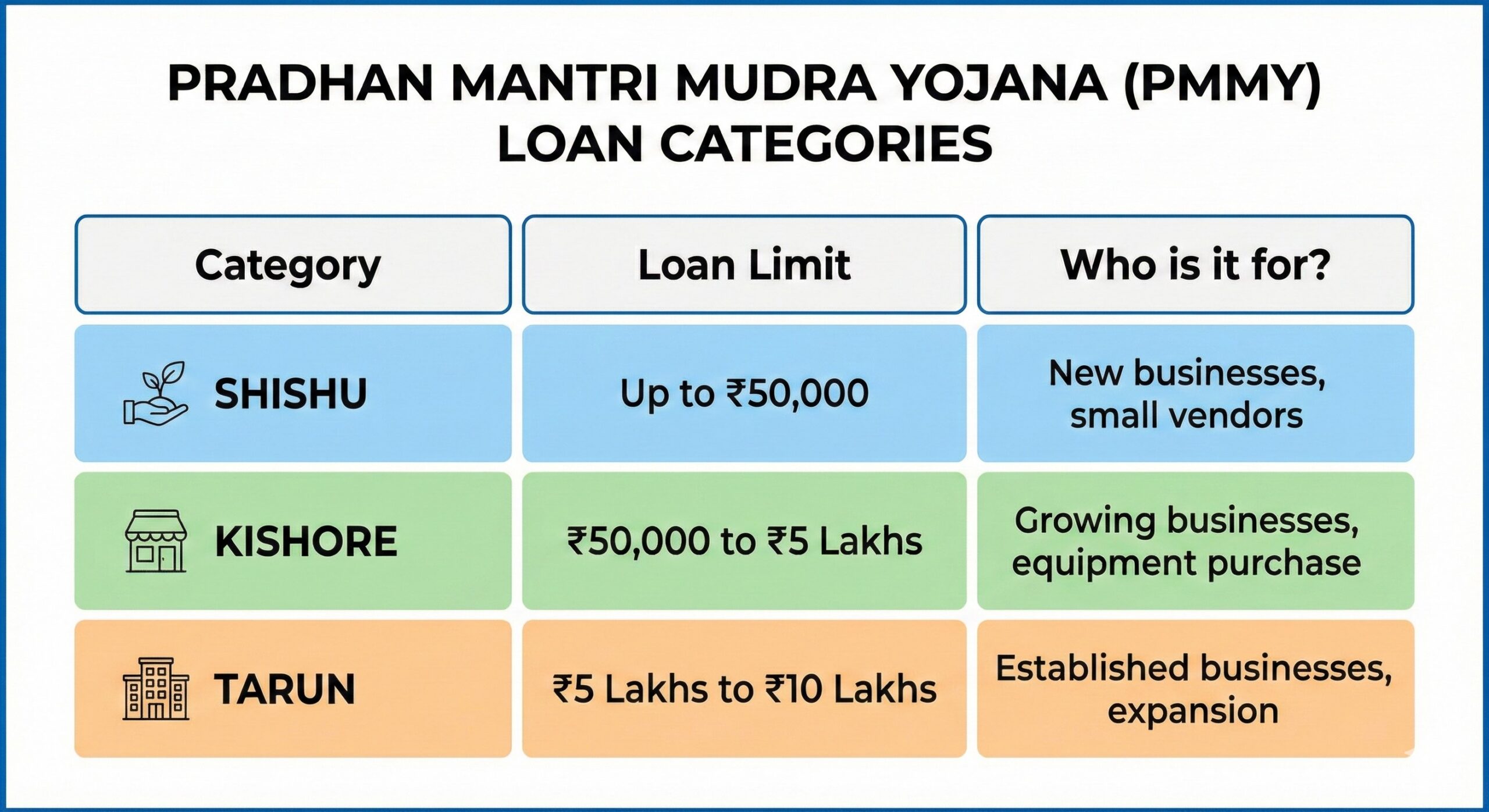
For the Indian middle class and small shop owners, the PMMY (Mudra Loan) is the most accessible option. The biggest advantage is that it is a Collateral-Free Loan, meaning you do not have to mortgage your house or shop to get the money.
The Three Categories of Mudra Loans:
- Shishu (For Startups & Beginners): Loans up to ₹50,000.
- Who is it for? New businesses, vegetable vendors, small tea stalls, or home-based businesses like tiffin services.
- Purpose: Buying small machinery, raw materials, or setting up a cart.
- Interest: Very affordable.
- Kishore (For Growing Businesses): Loans from ₹50,000 to ₹5 Lakhs.
- Who is it for? Established shopkeepers who want to increase stock or buy equipment. E.g., A salon owner buying new chairs and ACs.
- Purpose: Working capital and equipment purchase.
- Tarun (For Established Expansion): Loans from ₹5 Lakhs to ₹10 Lakhs.
- Who is it for? Businesses that are stable and ready to scale up. E.g., A grocery store expanding into a mini-supermarket.
- Requirement: Strict verification of previous years’ balance sheets and IT returns is usually done here.
How to Apply: Mudra loans are not given directly by the government. You must approach a Commercial Bank, RRB, Small Finance Bank, or MFI to apply for a Mudra loan.
Complete Checklist of Documents Required
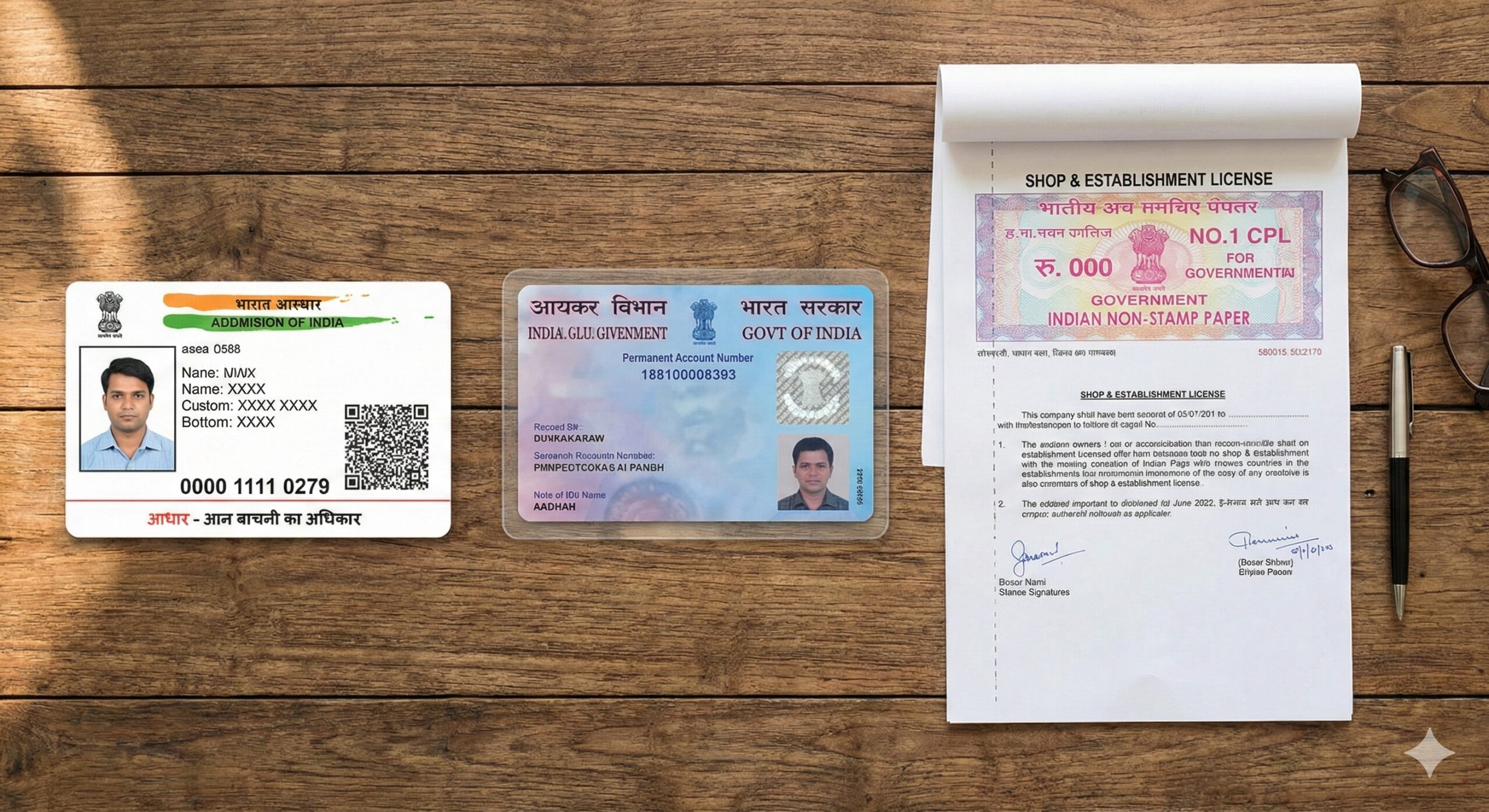
Organization is key. If you walk into a bank with a messy file, the manager loses confidence. Have these documents neatly arranged in a file folder.
A. KYC Documents (Identity & Address)
- Identity Proof: Aadhar Card, PAN Card (Mandatory), Voter ID, or Passport.
- Address Proof: Electricity bill of the residence, Ration card, or Rent agreement.
- Photos: Recent passport-sized photographs of the applicant.
B. Business Proof (Crucial for Shop Loans)
- Udyam Registration Certificate: This is the Aadhar for your business. It is free and can be done online. It proves you are an MSME.
- Shop & Establishment License (Gumasta): Issued by your local municipality.
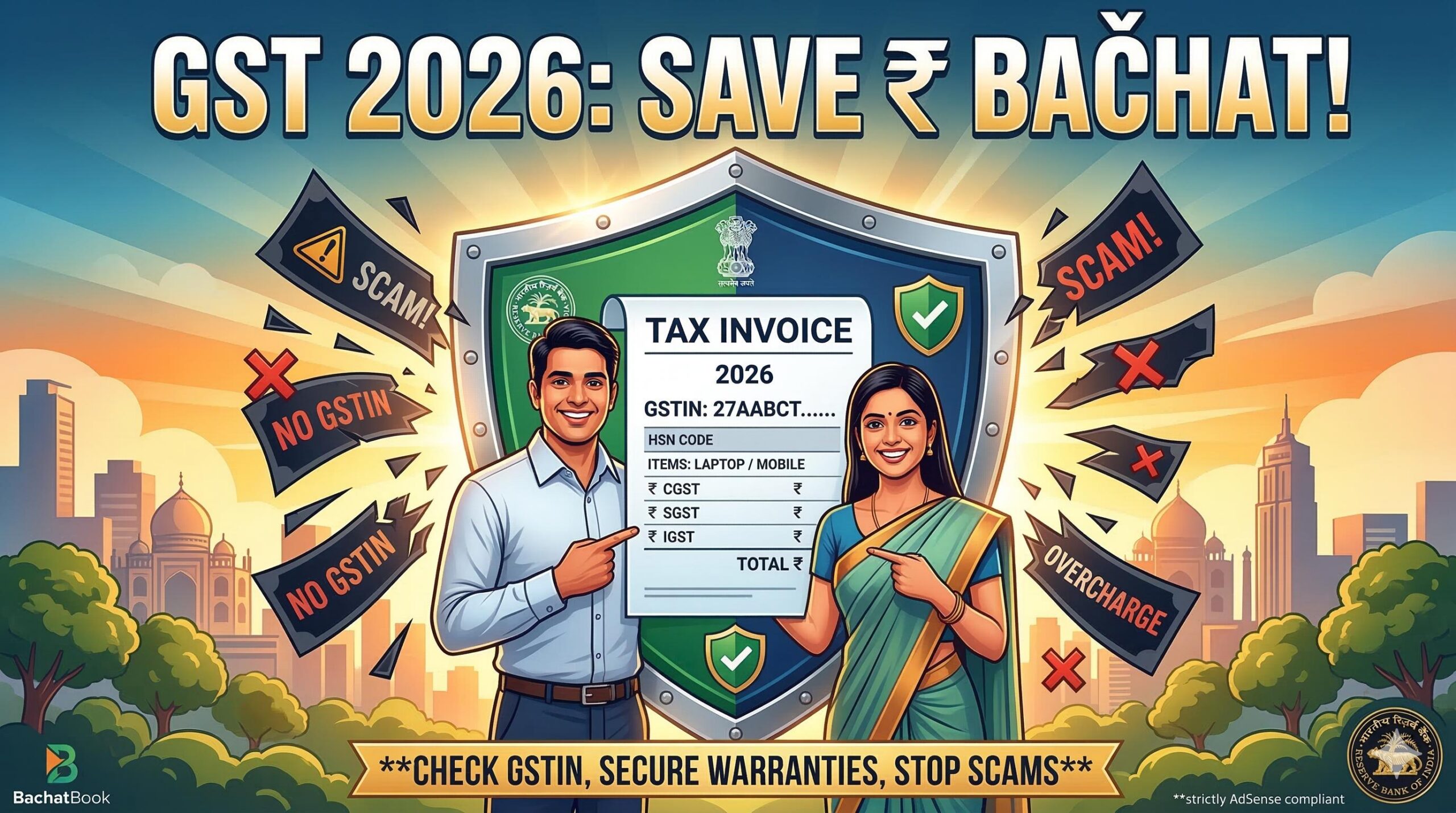
- GST Registration: (If your turnover is above the GST limit, usually ₹40 Lakhs for goods, but having it helps even for smaller shops).
- Current Account Statement: Last 6 to 12 months’ bank statement showing business transactions.
C. Financial Documents (For loans above ₹5 Lakhs)
- Income Tax Returns (ITR): Last 2 years’ ITR computations.
- Balance Sheet & Profit/Loss Statement: Audited by a CA (usually for larger loans).
- Project Report: A simple document explaining your business plan (required for new Term Loans).
Smart Tips to Get Low-Interest Rates
Interest rates can eat into your profit margins. Here is how to negotiate the best deal:
- Maintain a Healthy Bank Balance: Don’t withdraw all your money as soon as it comes in. Keep a decent “Average Monthly Balance.” This shows the bank you have liquidity.
- Route Sales Through Bank: Use QR codes and UPI for payments. When sales money goes directly into the bank, the bank sees your real income. A healthy turnover on paper equals lower interest rates.
- Existing Relationship: Apply to the bank where you already have a Savings or Current account. They know your history and are more likely to offer “Pre-approved” offers with lower rates.
- Compare APR, Not Just EMI: Some agents will confuse you with “Flat Rate” vs. “Reducing Rate.” Always ask for the Reducing Balance Interest Rate. A 10% Flat rate is actually much more expensive than a 14% Reducing rate.
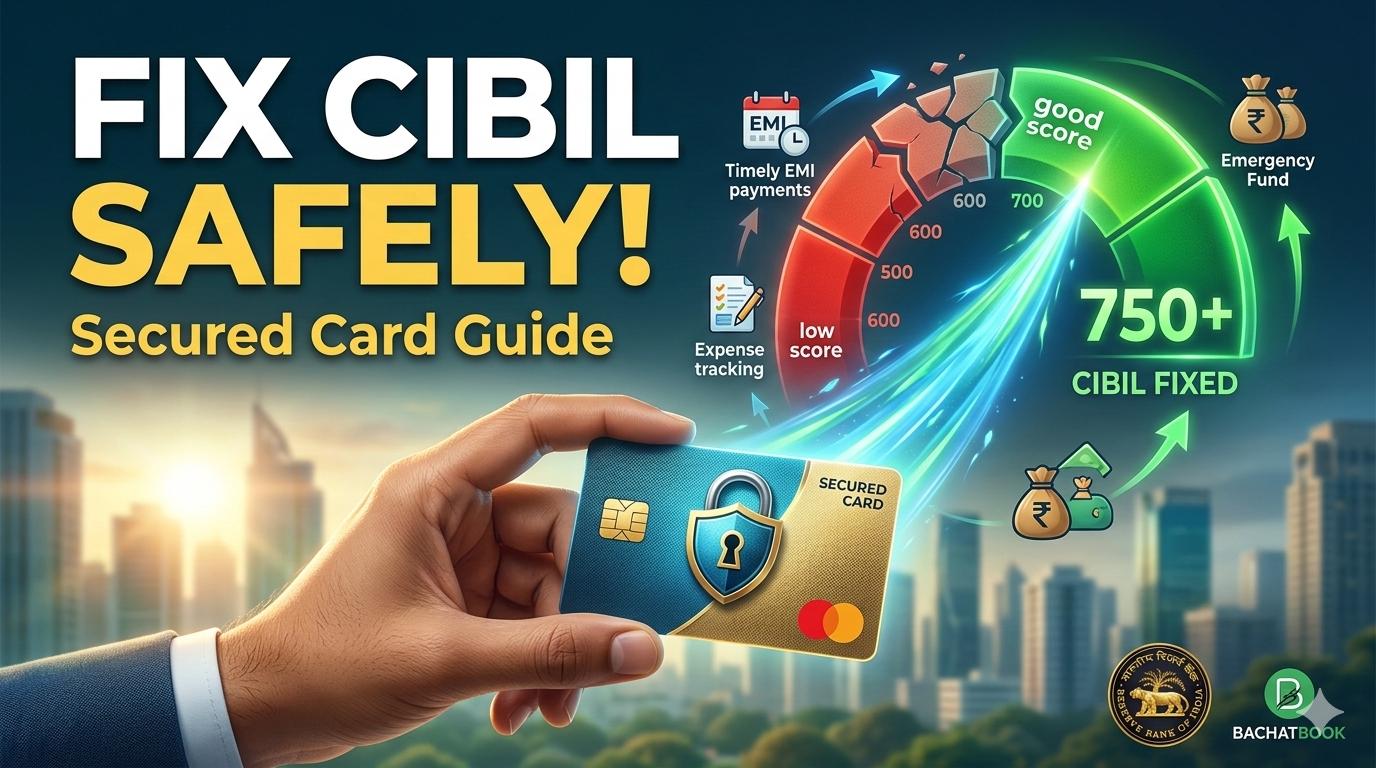
- Score High on CIBIL: Before applying, pay off any small pending credit card dues. A score of 750+ gives you the power to negotiate for a 0.5% – 1% discount on interest.
Digital Tools That Help You Get Loan Approval
In 2026, technology is your friend. Using digital tools makes your business look professional and trustworthy to banks.
- Udyam Registration Portal: Use this government site to register your business officially. It makes you eligible for priority sector lending.
- JanSamarth Portal: This is a unified government platform where you can check eligibility for 13+ credit-linked government schemes (including Mudra) in one place.
- Digital Ledger Apps (KhataBook / OkCredit): Instead of paper notebooks, use these apps. They can generate reports showing your receivables, which can act as supporting documents for your business volume.
- CIBIL Official Site: Check your own report once a year to ensure there are no errors (like a closed loan still showing as active) that could hurt your chances.
Long-Term Financial Habits for Shopkeepers
Getting the loan is only step one. Successfully repaying it ensures your business survives and grows.
- Separate Business and Personal Cash: This is the Golden Rule. Do not pay your child’s school fees from the shop’s cash drawer. Take a fixed “salary” from your shop every month and run your house with that. Leave the rest in the business.
- Automate EMI Payments: Set up an “Auto-Debit” or NACH mandate for your loan EMI. Missing an EMI date because you “forgot” attracts a heavy penalty and ruins your credit score instantly.
- Build an Emergency Fund: Business has ups and downs. Sales might drop during monsoons. Keep 3 months’ worth of EMI amounts in a separate Fixed Deposit (FD). Use this only if you cannot pay the EMI from daily sales.
- Review Expenses Monthly: Sit down on the last day of every month. Check where the money went. Are you spending too much on tea/snacks for staff? Can you reduce electricity bills? Small savings add up to one EMI.
FAQ Section (Frequently Asked Questions)
Q1: What is the minimum interest rate for a shop loan in India? A: Interest rates usually start from 8.50% to 11% p.a. for government schemes like Mudra or loans from public sector banks (SBI/PNB). Private banks and NBFCs may charge 14% to 24% depending on your risk profile.
Q2: I have a small tea stall. Can I get a loan? A: Absolutely. You fall under the “Shishu” category of Mudra Yojana. You can get up to ₹50,000 to buy tables, chairs, or raw materials. You just need an Aadhar card and a simple business plan.
Q3: Is collateral (security) required for a ₹5 Lakh loan? A: Generally, no. Under the CGTMSE scheme, the government encourages banks to provide collateral-free loans up to ₹10 Lakhs (and sometimes up to ₹2 Crores) to MSMEs. However, the bank manager has the final say based on your credibility.
Q4: My CIBIL score is 650. Can I still get a loan? A: It is difficult to get a loan from top banks with a 650 score. You may have to approach NBFCs or Micro Finance Institutions (MFIs). They may give you a loan but will charge a higher interest rate (likely 20%+).
Q5: Can I apply for a loan online? A: Yes. Portals like Udyamimitra and JanSamarth allow you to apply to multiple banks with one form. Most private banks also have “Insta-Loan” options on their mobile apps for existing customers.
Q6: What happens if I cannot repay the loan? A: If you miss an EMI, you pay a penalty. If you miss 3 consecutive EMIs, your loan becomes an NPA (Non-Performing Asset). The bank can take legal action, and your CIBIL score will be ruined, preventing you from ever getting a loan again. Always talk to the bank if you are facing genuine difficulty—they may restructure your loan.
Know More: Mudra Loan Shishu Eligibility 2026: Complete Guide for Small Business Owners
Conclusion
Running a shop in India is not just a job; it is a legacy that supports your family and serves your community. While the question “Dukan ke liye loan kaise milta hai” brought you to this article, the real answer goes beyond just filling out a bank form; it is about preparing yourself to become a trusted borrower. Throughout this guide, we have learned that banks are not your enemies but businesses looking for safe partners. When you walk in with a Registered Business (Udyam), a strong CIBIL Score, and a clear plan to use the money for growth—whether it is for new stock, renovation, or machinery—you stop being a “risky applicant” and become a “valued customer.”
To succeed, you must remember three golden rules: document everything by moving away from kaccha bills to create a financial footprint, borrow smartly using schemes like the Pradhan Mantri Mudra Yojana, and maintain discipline by strictly separating your home expenses from your shop’s EMI. Do not let the fear of paperwork stop your growth, as every big showroom you see in the market today likely started as a small shop that took a calculated risk at the right time. Now, it is your turn to gather your documents, check your eligibility on the JanSamarth Portal, and take that first confident step towards expanding your business.
Disclaimer: This content is strictly for educational purposes. We are not financial advisors. Loan approval is at the sole discretion of the bank. Please read all terms and conditions carefully before signing any loan agreement.