
Introduction
In 2026, managing a household budget in India has become as complex and demanding as running a small business. We are living in an era of rapid inflation where the price of essential commodities—from cooking oil and pulses to petrol and school fees—fluctuates constantly. For the average middle-class family or salaried employee, the margin for error is shrinking day by day. A single month of uncontrolled spending or a lack of planning can disrupt your financial stability for the rest of the quarter, leading to unnecessary stress.
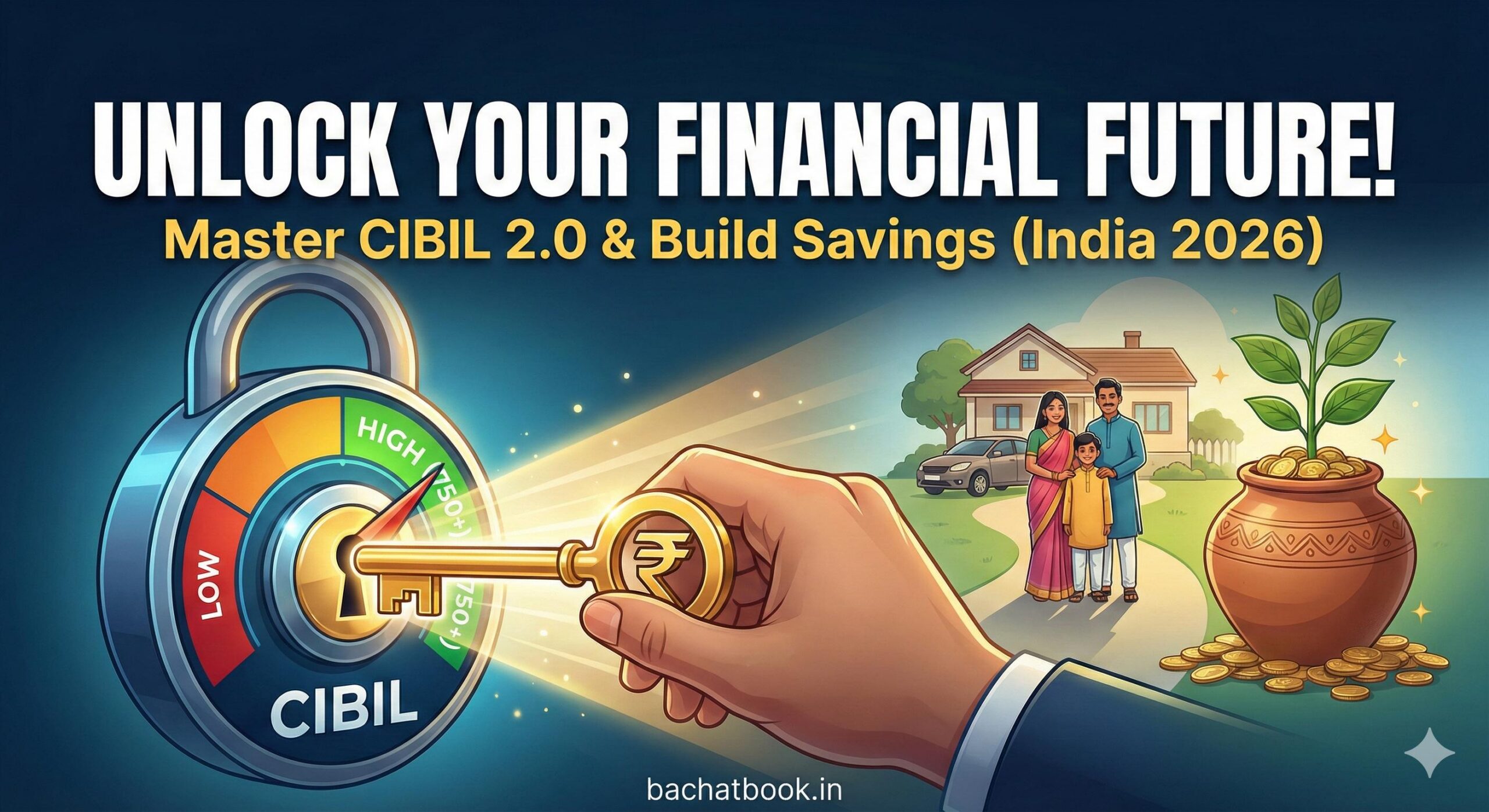
When we talk about saving money, we often think only of cutting costs on groceries or electricity. However, true financial health involves understanding your entire financial profile, including your creditworthiness. This is where understanding CIBIL 2.0 scoring factors becomes essential. Just as you track your monthly expenses to save money, banks track your credit behavior to decide if you are a safe borrower. A high score can save you lakhs of rupees in interest rates over your lifetime, which is arguably the biggest saving of all.
Saving money is not about being stingy or denying yourself happiness; it is about efficiency. It is about knowing exactly what you have (your inventory of cash and resources) and exactly where it is going. This guide is based on common financial habits and challenges faced by Indian households. It will walk you through a realistic, detailed approach to budgeting that adapts professional financial discipline to your daily life, helping you build a secure financial future regardless of your income level.
Disclaimer: This article is for educational and informational purposes only. It does not constitute professional financial advice or investment recommendations. Please consult a certified financial advisor for specific guidance tailored to your situation.
Table of Contents
Why Saving Money Is Important in India
In the Indian cultural context, saving has always been a core value. However, the reasons for saving have evolved from simple “future security” to immediate survival and lifestyle maintenance. We need to look beyond just “saving for a rainy day” and understand the structural necessity of capital.
The Emergency Fund Shield
Life is unpredictable. A sudden medical emergency requiring hospitalization in a private facility can cost lakhs of rupees in a matter of days. Similarly, a sudden breakdown of your car or a necessary home repair during the monsoon can derail your monthly budget instantly. Without a solid “Emergency Fund”—usually 3 to 6 months of expenses kept in a savings account—you are vulnerable to high-interest debt from credit cards or personal loans. Savings act as a financial shield, protecting your family from panic during crises.
Family Responsibilities
Most Indians operate within a close-knit family structure. We often find ourselves in the “Sandwich Generation,” supporting aging parents with healthcare needs while simultaneously raising young children. Healthcare for seniors and quality higher education for children are two massive expenses that are rising faster than general inflation. These are not costs you can manage with a single month’s salary; they require years of disciplined, systematic accumulation.
Job and Income Uncertainty
The modern economy is dynamic but volatile. For salaried employees, there is the constant risk of market shifts, automation, or layoffs. For freelancers and small business owners, income can be irregular and seasonal. Having a robust savings buffer ensures you have a “financial runway” to survive lean periods without compromising your standard of living or falling into a debt trap.
Future Goals and Aspirations
Everyone has a dream—whether it is buying a home in a decent locality, upgrading to a better car, or planning a stress-free retirement where you don’t depend on your children. These goals turn into reality only when you stop spending on temporary pleasures and start saving for permanent assets. Understanding CIBIL 2.0 scoring factors early on ensures that when you are ready for these big purchases, you get the best loan offers available.
Common Reasons Indians Fail to Save Money
Despite understanding the importance of saving, many Indian families struggle to retain money at the end of the month. The barriers are often behavioral and psychological rather than a lack of income.
Lack of Budgeting (The “Mental Math” Trap)
Most people rely on “Mental Accounting.” They believe they know where their money goes, but they are often wrong. They might track big expenses like rent or EMI but completely ignore the hundreds of small UPI transactions for snacks, tea, rickshaw fares, or online subscriptions. Without a written budget, these small “leaks” sink the ship. If you don’t track it, you can’t save it.
Impulse Spending and Instant Delivery
The rise of “10-minute delivery” apps and constant “Mega Sales” on e-commerce platforms has made impulse buying a major issue in India. The convenience of getting anything delivered instantly triggers the “want” center of our brain, bypassing the logical “need” center. We end up buying things we don’t need simply because the buying process is so easy and frictionless.
EMI Overload
“No Cost EMI” is a marketing tool that often leads to overspending. It breaks a large price tag into small, seemingly affordable chunks. A ₹50,000 phone seems cheap at ₹4,000 a month. However, when you stack four or five such EMIs, a significant portion of your future income is already spent before you even earn it, leaving absolutely no room for savings or investments. This high credit utilization can also negatively impact your CIBIL 2.0 scoring factors.
Lifestyle Inflation
This is the silent wealth killer. When your income increases, your expenses immediately increase to match it. You move to a slightly bigger house, switch to premium brands, and dine at costlier restaurants. This ensures that your savings rate remains flat, even if your salary doubles over five years. You end up running faster just to stay in the same place financially.
Step-by-Step Monthly Budgeting Method
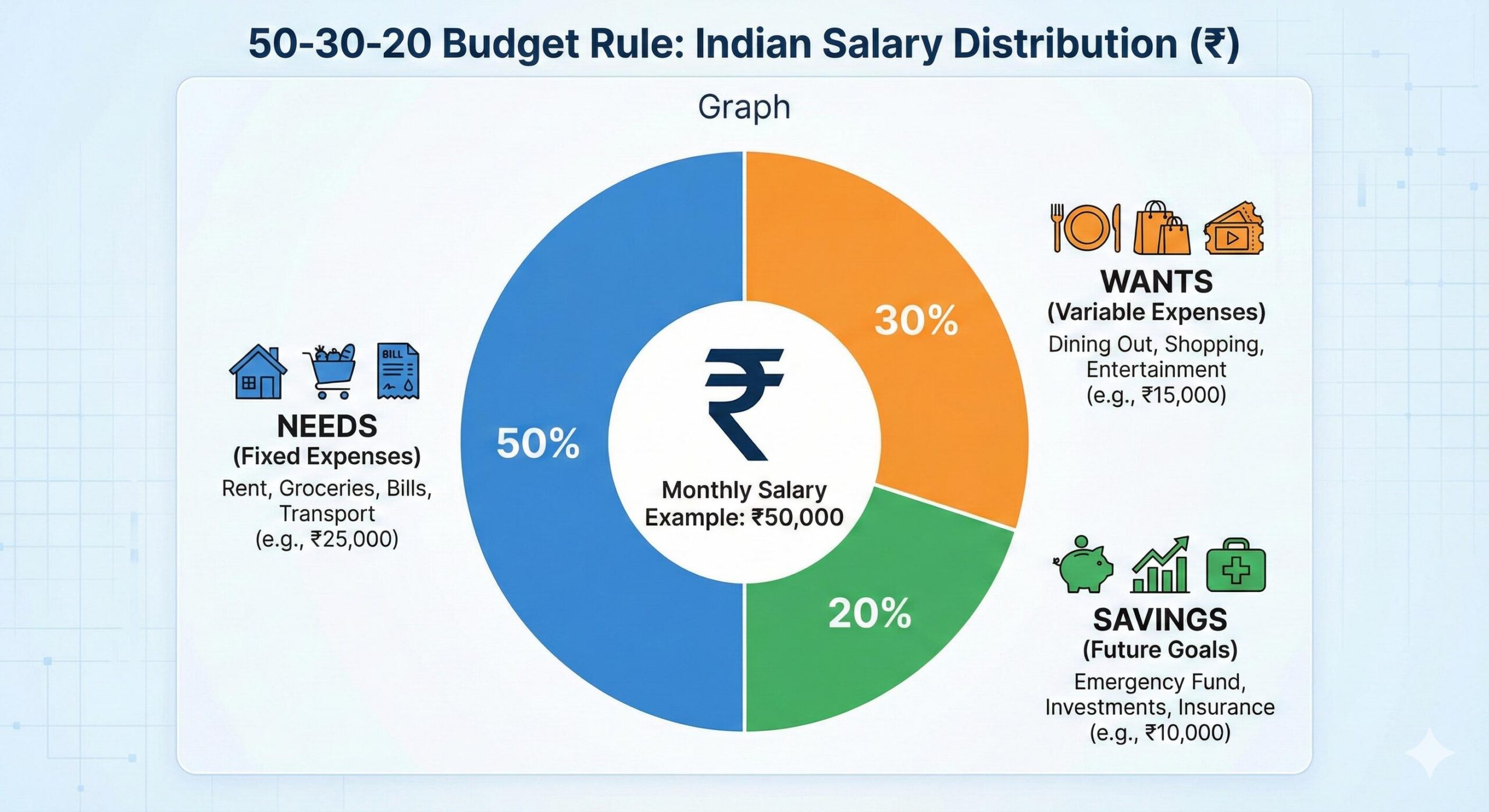
To take control of your money, you need a system. We recommend the 50-30-20 Rule, customized for the Indian context. Below is a detailed breakdown assuming a monthly in-hand salary of ₹50,000.
| Category | Percentage | Amount (₹) | What it Includes |
| Needs (Fixed) | 50% | ₹25,000 | Rent, EMI, Groceries, Electricity, School Fees, Transport |
| Wants (Variable) | 30% | ₹15,000 | Dining out, OTT Apps, Shopping, Hobbies, Travel |
| Savings (Future) | 20% | ₹10,000 | SIPs, PPF, Emergency Fund, Insurance Premiums |
Step 1: Calculate Net Income
Start with your “Net Income”—the actual amount that hits your bank account after Provident Fund (PF), Tax (TDS), and other deductions. Do not budget based on your “CTC” (Cost to Company); budget based on your “Cash in Hand.”
Step 2: Fixed Expenses (Needs) – 50%
These are survival expenses. You cannot avoid them. If your needs exceed 50% of your income, you are in the “danger zone.” You may need to look for cheaper accommodation or reduce utility usage immediately. Timely payment of these bills, especially credit card bills or loan EMIs, is crucial because payment history is one of the most critical CIBIL 2.0 scoring factors.
Step 3: Variable Expenses (Wants) – 30%
These are lifestyle choices. These make life enjoyable but are not essential for survival. This is the first place to cut when you are short on cash. Treat your household “wants” with strict scrutiny—if it’s not adding value, cut it out.
Step 4: Savings & Investments – 20%
This category is for your future self. It should be treated as a “bill” you must pay to yourself. Automate this. Set a standing instruction so that as soon as your salary is credited, 20% is automatically moved to a separate investment or savings account.
Smart Money Saving Tips for Indian Households
Every Indian household has “hidden money” lying in wastage. Here is how to find it and save it.
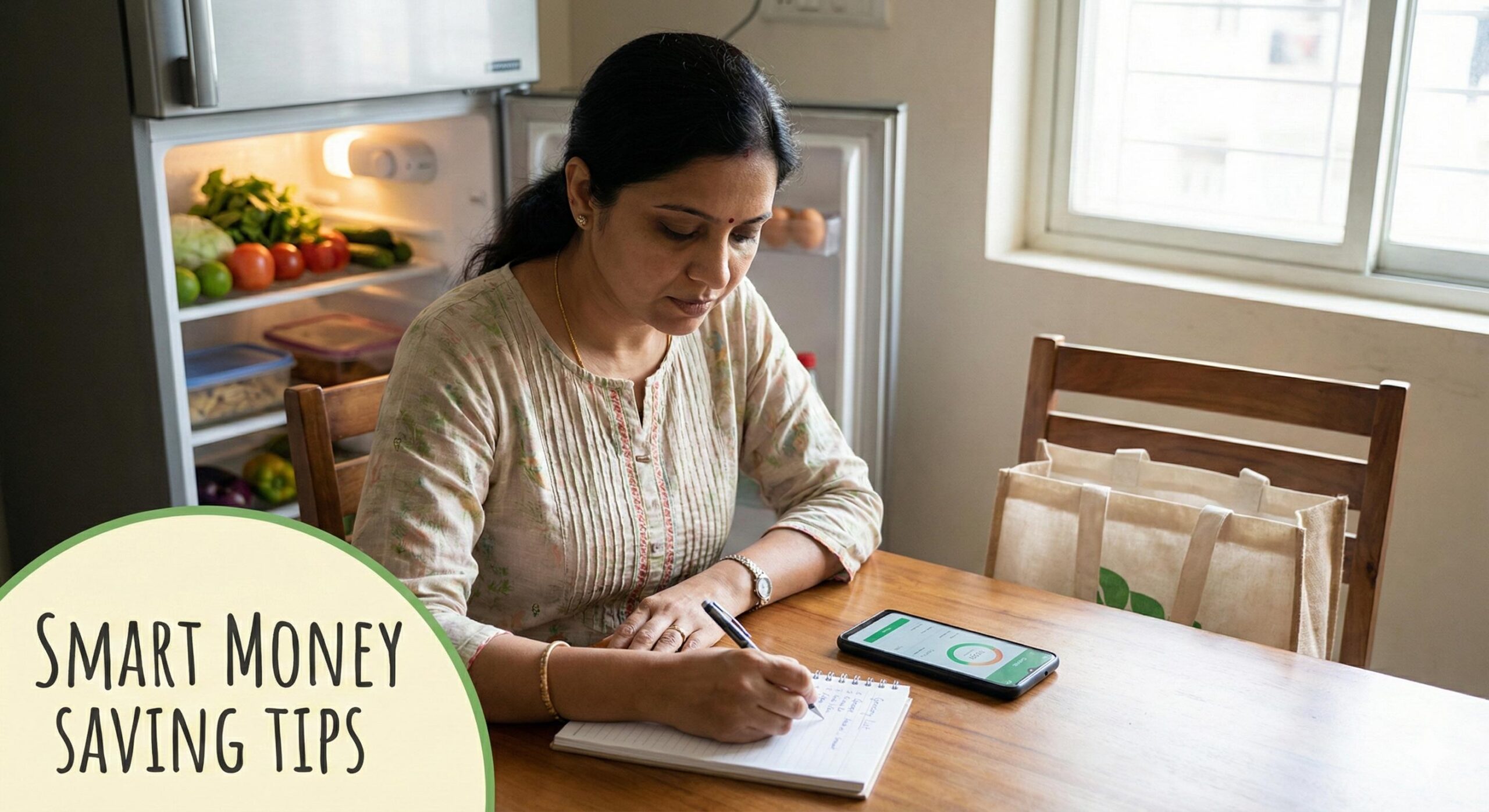
Grocery Savings: The “Home Inventory” Concept
Businesses use inventory management to ensure nothing is wasted. You should do the same in your kitchen.
- Check Your Stock: Before going to the market, check your pantry. Do you already have two packets of Dal? Don’t buy a third. Use what you have.
- The List Rule: Never shop without a list. Supermarkets are designed to make you impulse buy. A list is your defense against marketing tricks.
- Buy Seasonal: In India, vegetables and fruits have seasons. Buying cauliflower (Gobi) in summer or mangoes in winter will cost you double. Stick to seasonal produce to save significantly.
Electricity & Gas Optimization
Switch off the main plug for TVs, Microwaves, and Computers when not in use. Even in standby mode, they consume “Phantom Power.” Running an AC at 24 degrees is healthy and consumes much less power than running it at 18 degrees. Ensure your gas burner flame is blue. A yellow flame indicates wastage. Always soak dals and rice before cooking; this reduces cooking time and saves LPG.
Mobile & Internet Bills
Instead of individual recharges for every family member, opt for a family postpaid plan or a shared broadband connection which is often more value-for-money. Review your subscriptions: Do you really need three different OTT platforms? Rotate your subscriptions. Subscribe to one for a month, watch what you want, cancel it, and switch to another.
Saving Money for Students & Young Earners
If you are a student or in your first job, you have the greatest asset of all: Time. Compound interest works best when you start early.

Pocket Money Management
Treat your pocket money like a salary. If you receive ₹2,000 a month, try to save ₹500 immediately. Open a zero-balance savings account and deposit this amount. Do not touch it. By the end of the year, you will have ₹6,000 plus interest—enough for a course or a small trip.
The “Latte Factor” (Chai/Sutta Cost)
Small daily habits drain wallets. A ₹20 chai and a ₹15 snack twice a day equals ₹70 daily. That is ₹2,100 a month and roughly ₹25,000 a year! We aren’t saying don’t enjoy chai, but be aware of how much “small” spending costs you annually.
Used Books and Resources
Never buy brand new textbooks unless necessary. Look for seniors selling old books, visit second-hand book markets, or use digital PDFs.
Avoid Debt Traps
Banks love to offer “Lifetime Free Credit Cards” to young earners. Be very careful. If you miss one payment, the interest rate can be 40% per annum. Using credit responsibly is good, but using it to buy things you can’t afford is the path to financial ruin. Mismanaging a credit card early in life can damage your record based on CIBIL 2.0 scoring factors, making it hard to get loans later.
Digital Tools That Help Save Money
In the digital age, you should use technology to stay disciplined.
- Expense Tracking Apps: Use apps (like Walnut, Moneyfy, or Splitwise) that read your transaction SMS and automatically categorize your spending into “Food,” “Travel,” and “Shopping.” This gives you a clear pie chart of your expenses at the end of the month.
- Price History Trackers: Before buying anything on Amazon or Flipkart, use a price tracker extension to see if the “discount” is real or fake.
- UPI Limits: Many UPI apps allow you to set a daily transaction limit. Set a limit for yourself (e.g., ₹500 per day for casual spending). If you cross it, the app will block the transaction, forcing you to rethink the purchase.
Long-Term Saving Habits Indians Should Build
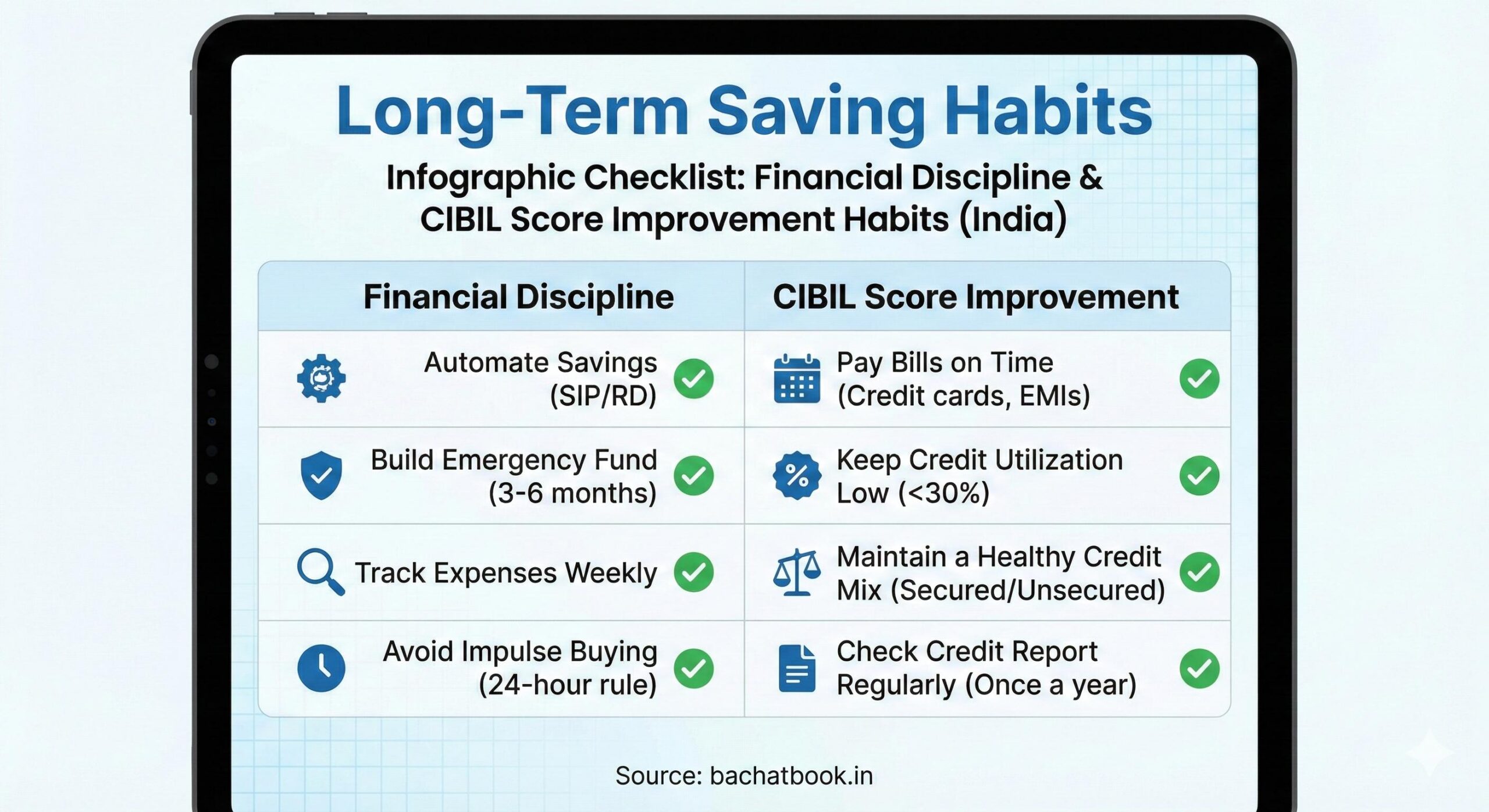
The 24-Hour Rule
Whenever you feel the urge to buy something expensive (over ₹2,000), wait for 24 hours. Do not buy it immediately. In 80% of cases, the urge to buy will fade away by the next morning, proving it was an impulse want, not a need.
Goal-Based Saving
Don’t just save for “saving’s sake.” Give your money a name. Open a Recurring Deposit (RD) named “Diwali Gift Fund” or a Liquid Fund named “Emergency Medical Fund.” When you see the name, you are less likely to withdraw that money for a trivial reason like buying a pizza.
Periodic Review (The Sunday Ritual)
Every Sunday night, spend 15 minutes reviewing your bank statement or UPI history. Identify one expense from the last week that was unnecessary and promise to avoid it next week. Also, check your credit report once a year to ensure all CIBIL 2.0 scoring factors like payment history and credit mix are accurately reflected.
CIBIL Score Repair 2026: A Practical Guide to Improving Your Credit Health in India
Frequently Asked Questions (FAQ)
How much should I save monthly in India?
Ideally, aim for 20% of your monthly income. However, if you are on a tight budget, start with 5% or 10%. The habit of saving is more important than the amount initially. As your income grows, increase the percentage.
What are the key CIBIL 2.0 scoring factors I should know?
The primary factors include your repayment history (do you pay bills on time?), credit utilization ratio (how much of your limit do you use?), the age of your credit history, and your mix of secured and unsecured loans. Maintaining a healthy balance in these areas improves your score.
Is budgeting necessary for low-income families?
Yes, budgeting is more critical for low income. It ensures your basic needs are met without falling into debt traps. When resources are limited, every rupee must be assigned a specific job.
How can families save money easily without sacrificing quality of life?
Focus on the “Big Three”: Rent, Food, and Transport. Reducing costs in these areas yields the highest savings. Also, cutting “invisible waste”—like electricity wastage and food wastage—helps significantly.
What are common money mistakes young Indians make?
Overspending on lifestyle (cafes, expensive phones) to impress peers and ignoring health insurance are major mistakes. Delaying investments because “I don’t have enough money” is also a common error; you can start with as little as ₹500.
What is the best way to build an emergency fund?
Start by setting aside a small amount daily or weekly in a separate savings account. Aim to accumulate an amount equal to at least 3 months of your essential household expenses.
Conclusion
Saving money is not about living a miserable life; it is about spending money on things that truly matter to you and cutting back on things that don’t. It is about prioritizing your peace of mind over temporary pleasures. When you have money in the bank, you walk with confidence. You don’t fear the end of the month, and you certainly don’t need to panic when a small crisis hits.
Just as banks analyze CIBIL 2.0 scoring factors to determine financial reliability, you must analyze your own spending habits to ensure your household’s reliability. Start small. You do not need to overhaul your life overnight. Start by tracking your expenses today, make one small cut in your spending tomorrow, and watch your bachat (savings) grow over time. Your future self will thank you for the discipline you show today.